Tuesday, November 12, 2013

#373 Urbano Lugo


Card thoughts: This is Urbano Lugo’s rookie card, and as indicative of the poor rookie crop that Topps featured in this set, Lugo would only get one other card. His father, identically named, had a card issued for him by Topps when he pitched in the Venezuelan League.

After a decent, but not spectacular minor league career (13 wins in both ’83 and ’84), Lugo began the 1985 campaign in the minors, but was recalled for use in the bullpen. At first only used when the Angels were losing, Lugo was propelled into the rotation on June 11, where he lasted just 4 innings giving up 3 runs. But the Angels won his next 6 starts, with him factoring in three of the decisions. But Lugo could not sustain his success, and after being unable to make it past five innings in his next three starts (he lost all three, giving up 13 runs in 12 innings), he was sent back to the bullpen where he appeared extremely sporadically for the rest of the season.

In 1986, he spent most of the season with AAA Edmonton, going 8-6, only resurfacing for a couple of spot starts and relief appearances after rosters were expanded in September (despite which, he got a Topps card). In the winter, he pitched a no-hitter in the Venezuelan League.

Lugo broke camp with the Angels the following year, but he was abysmal as a starter, giving up at least a run an inning (including 8 in 5 innings on May 1), before being sent to the minors for good later that month.

No longer in the Angels long term plans, Lugo was released and signed by the Expos in 1989 (where he barely pitched), and a year later by the Tigers, where he appeared in 13 games in April and May, with terrible results again, especially in relief (for instance, he gave up 6 hits (including 3 home runs) and 5 runs to the Blue Jays on May 6, turning a close game into a rout.

Lugo, a pretty big wheel in his native Venezuela, runs free baseball clinics in his home country. Unlike on his baseball cards, his photo is all smiles.


Rear guard: Merv Rettenmund was one of the better pinch hitters in the 70s. His grand slam in '78 was his only one that year. Here's his card from that season.

Thursday, November 7, 2013

#372 Ben Ogilve


Card thoughts: Pensive. Serene. How appropriate.

The player: Born in Panama, but raised in the Bronx, it took quite a long time for Ben Ogilve to establish himself as a legit everyday player.  He found it hard to break into the Red Sox outfield in the early 70s, as the Red Sox were solid there with Carl Yastrzemski, Reggie Smith, and Tommy Harper out there.  Part of the reason was his defense. Although he had a good arm, Ogilve had a tendency to over run the ball, which led to batters taking an extra base on him. He also had not filled out yet. Gangly and a little clumsy, Ogilve was derisively nicknamed “Spiderman” by the club.

Ogilve got more chances when he was traded to the Tigers for infielder Dick McAuliffe in 1973. Appearing in over 100 games for the first time as a platoon partner with Dan Meyer, he did exhibit the power he would in later years, but hit a respectable .286. The power began to show up in 1976, when he hit 15 home runs (while playing more often as a designated hitter) and 21 as the regular right fielder the following year. But despite his success with the Tigers, like the Red Sox they never really believed in his talent. Once again, a derisive nickname was attached to Ogilve: the “Banana Man” (because he ate a lot of bananas, but note the racist overtones).

Ogilve tried to not let the lack of faith get to him. Teammates seemed to think that he was a bit of a dunce, who lacked passion for the game. But he was a mellow fellow, who was into philosophy—reportedly, Rousseau, Plato, and Thoreau were among his favorites.

It was after the age of 30 when Ogilve really began to shine. With the Brewers, Ogilve was inserted more regularly into the lineup, usually in the fifth spot. He got his big break when incumbent right fielder Larry Hisle tore a rotator cuff early in 1978. By necessity, Ogilve became an everyday player.  In 1979, he drove in 81 runs while slugging .525. In 1980, he was even better, tying for the league lead in home runs with 41 while driving in 118. His league lead in intentional walks with 19 showed how much opposing pitchers respected Ogilve. And fans noticed as well. Ogilve was voted into the all-star game as the starting left fielder, over players like Rickey Henderson and Jim Rice. In the game, he went 0 for 2 with 1 walk.

Ogilve was a huge reason why the 1982 Brewers were nicknamed “Harvey’s Wallbangers.” Although his average dipped to .244, he slugged 34 homes and drove in 102 runs, while once again making the all-star squad as a reserve. In Game 5 of the ALCS, he hit an important home run off of Bruce Kison, for only his second hit of the series. He once again hit a solo home run in a deciding game, this time Game 7 of the World Series, but it was in a losing cause.

Ogilve would remain with the Brewers until 1986, a veteran presence who still commanded respect for his power, despite its decline over the years. He spent 1987 and 1988 with in the Japanese League, where he hit for both power and average. Since retirement, he’s been a hitting coach with various minor league clubs, most recently with the West Michigan Whitecaps (Class A). 


Rear guard: Ogilve's first three homer game came against the Tigers. His home runs drove in four of the Brewers five runs in that game.

Saturday, November 2, 2013

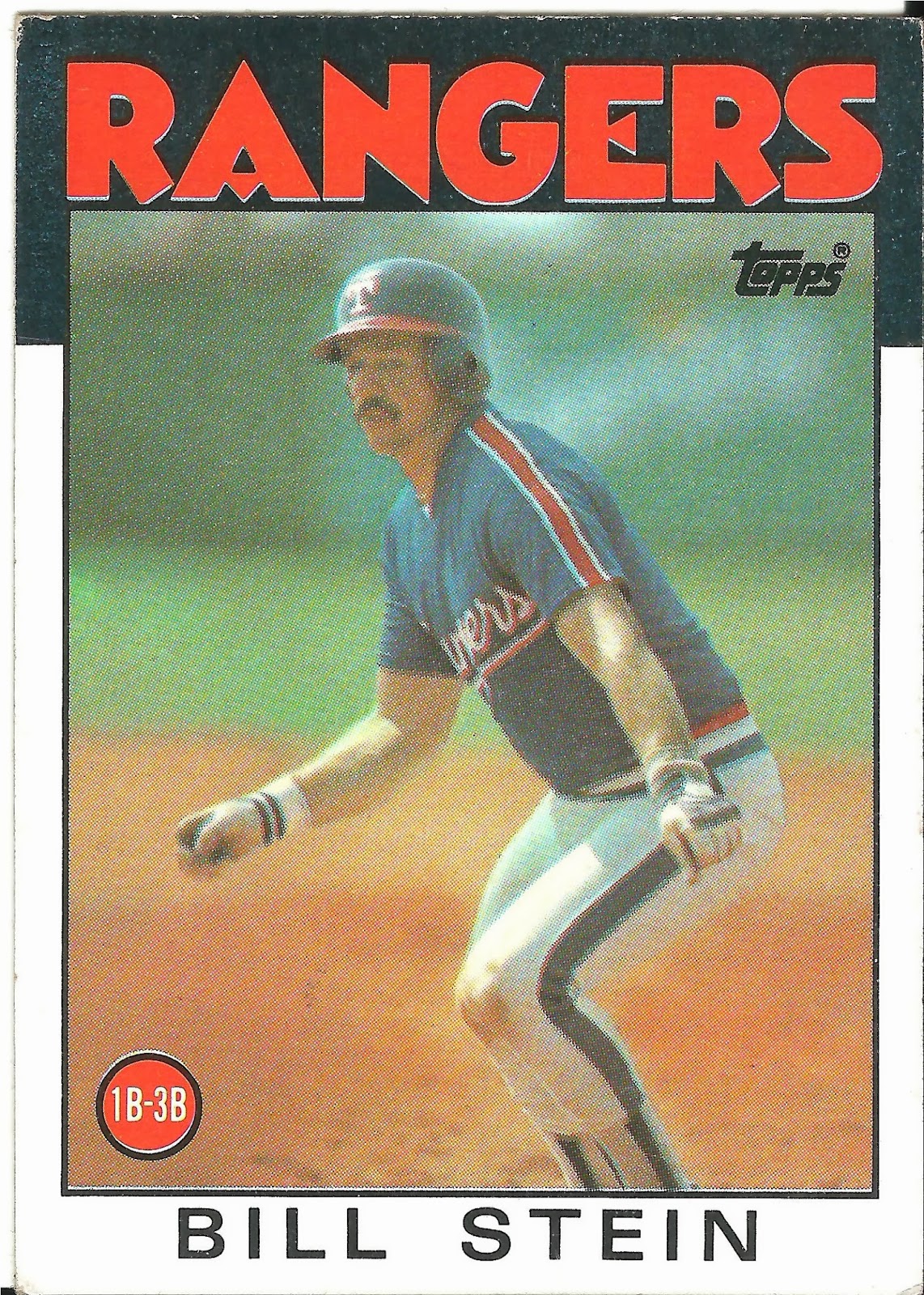
#371 Bill Stein


Card thoughts: Stein is doing the ever popular “basepath” surf. This would be his last card.

The player: Stein was pretty much a professional utility man upon his arrival in the majors in 1972. His only years as a regular came after the Mariners drafted him in the 1976 Expansion Draft.

Stein was originally signed by the nearby Cardinals out of Southern Illinois University, which was at that time a bit of a baseball powerhouse. As a college draftee, he was assigned to AAA Tulsa originally, and hit well there. But he was a man without a position. Although he could adequately play all the infield and outfield positions, he didn’t defend at any of them particularly well. This meant he was mostly stuck at AA and AAA until 1975, despite averaging a .295 average.

After a trade to the White Sox (via the Angels), Stein had his best season AAA, leading the league in hits, and hitting for power (.505 slugging percentage) for the first time. This earned him a permanent roster spot in 1975, and he even got a chance to play regularly at third (his best position) for a time when incumbent Bill Melton stopped hitting. But for the Sox his real value was a utility man, and he played all the infield positions and right field during the season.

Left exposed after the ’76 season, Stein was drafted by the Mariners, and he would turn in his finest major league season in 1977 as their regular third baseman, hitting 13 home runs and driving in 67. Twice during the season, he hit two homers in a game. Even his defense improved: His 146 putouts were tops among third basemen.

Unfortunately, this convinced the Mariners they had a solid third baseman for the next few years. They signed Stein to a three-year contract in 1978, but he would never approach those 1977 numbers again. A bruised hand sapped some of Stein’s power and defense, and he would lead third basemen in errors with 25, despite playing in only 111 games at the position (an abysmal .929 fielding percentage). The following year, he was injured much of the season, and his starting role was taken by Dan Meyer. So Stein went back to his old role as utility player.

While Stein still could hit, his lack of defense limited his utility. After a trade to the Rangers in 1981, he began to spend more time as a designated hitter and pinch hitter. Almost immediately he made his presence known, recording a record 7 pinch hits in row. For the year, Stein would hit a career high .330.

Stein would continue to excel off the bench, swatting .363 as a pinch hitter in 1982, driving in 7 runs that year, and the next. He was aging fast, however, and he only played in 27 games in 1984 as he nursed a wrist injury. The Rangers attempted to trade him after the season, but a physical showed a back problem, which invalidated a trade to the Pirates. Most believed that this spelled the end of Stein’s career, but with judicial use by manager Bobby Valentine, he managed to hit over .400 in a pinch hitting role.

The Rangers elected not to re-sign Stein after the season, and he retired. After retirement, he coached high school baseball for a season, and later spent time managing in the Mets and Giants systems. His career pinch hitting average was .282, with 2 home runs and 28 runs batted in.


Rear guard: In BIll Stein's final game, played this season, he struck out as a pinch hitter for Steve Buechele.