Showing posts with label Managers. Show all posts

Monday, May 12, 2014

#411 Sparky Anderson


Card thoughts: Sparky Anderson seems about a million years old in this picture (he is only 51!). A lifetime of sun and no sunblock will do that to you.

The player/manager: Like most managers, Anderson was no great shakes as a player. Strangely enough, he played just one season in the majors, but that was as the Phillies staring second baseman. In 152 Games in 1959, he hit .218, and then he never played another major league game.

But as a manager, Anderson was much more successful, although he tended to be a tad too boastful. He was hired at age 36 to be the Reds manager, and guided that team to two World Series wins and four pennants. One of his first acts as the Reds manager was install #1 Pete Rose as the team captain. He also made sure the team was disciplined, on and off the field. I n a time when spring training was still seen as a way too slowly gear up for the season after an off-season of lying about, Anderson insisted on organizing drills and having curfew times. Players were also required to be clean cut, and wear suits while travelling. In exchange, Anderson preferred to run the club as a type of extended Socratic dialogue, as players were encouraged to question his methods and actions.

One innovation Anderson introduced was pulling starters early. I’ll bet you’d be hard pressed to name a dominant pitcher on any of those Big Red Machine teams, but their relief corps was always top notch. Anderson was nicknamed “Captain Hook” for this tendency, which was notable in an age when starters were expected to finish games.

Eventually, in the late 70s the Reds hit a rough patch as their team aged. Anderson was fired after the 1978 season, and was about to sign a long contract with the Cubs (!) (oh what might have been!), when the Tigers hired him. The Tigers had a great core of young players, and Anderson disciplined them to become winners. He predicted they’d win a World Series in five years, which basically came true (they on after being in first wire-to-wire in 1984).


After being successful for years on teams that were “expected” to win, Anderson won with an overachieving Tigers team in 1987, winning the Manager of the Year award in the process. But his work ethic was taking a toll on him, and he was sent home for exhaustion for a few days in 1989. He ended up managing until 1995, but the Tigers teams he managed were uniformly terrible. He was elected into the Hal of Fame in 2000, having won the fifth most games all-time (2194 wins), having only lost 1834 (a .545 winning percentage).


Rear guard: No glaring omissions. No doubt Topps wanted to make sure they completely covered the reigning world champs.

Thursday, July 19, 2012

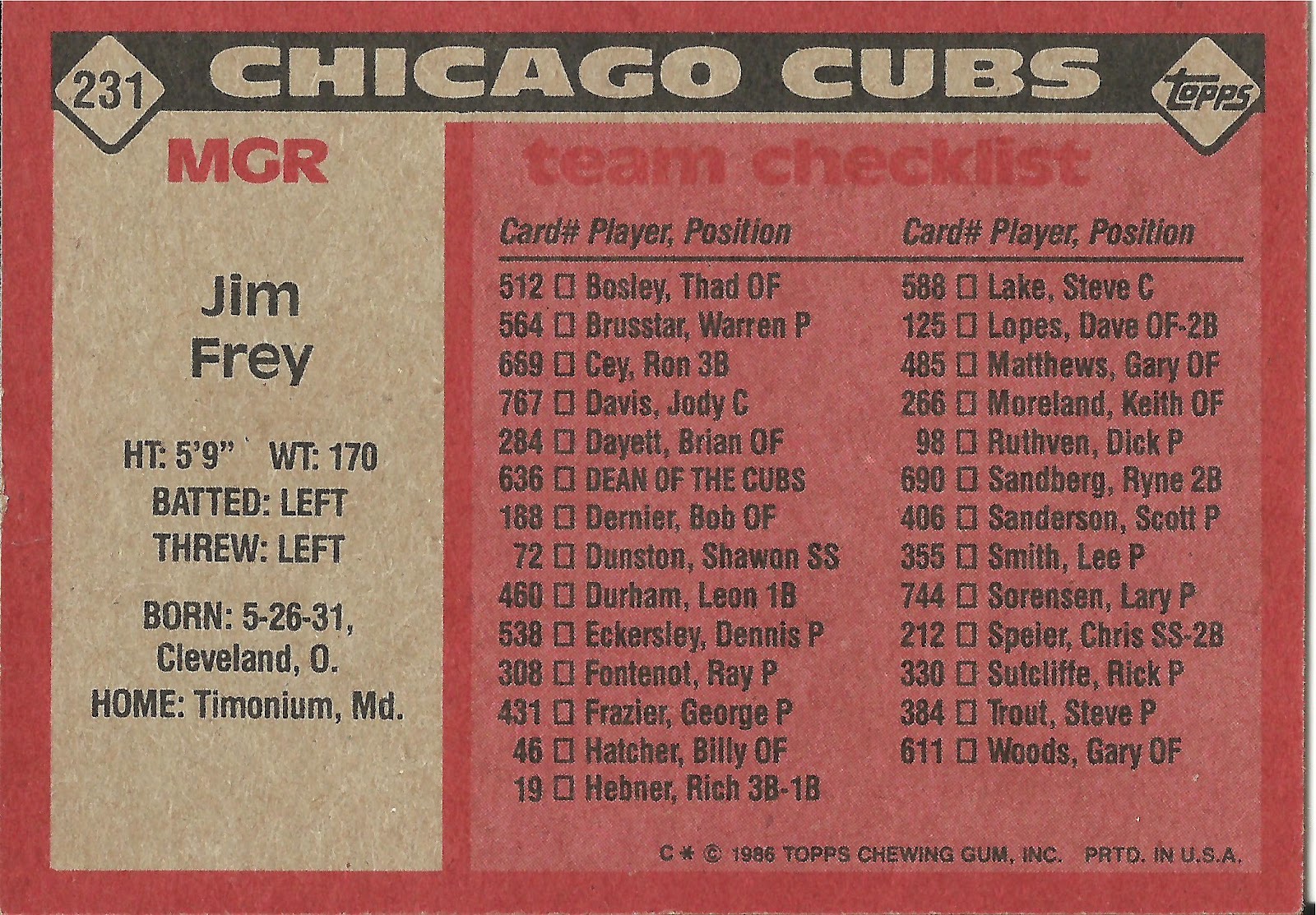
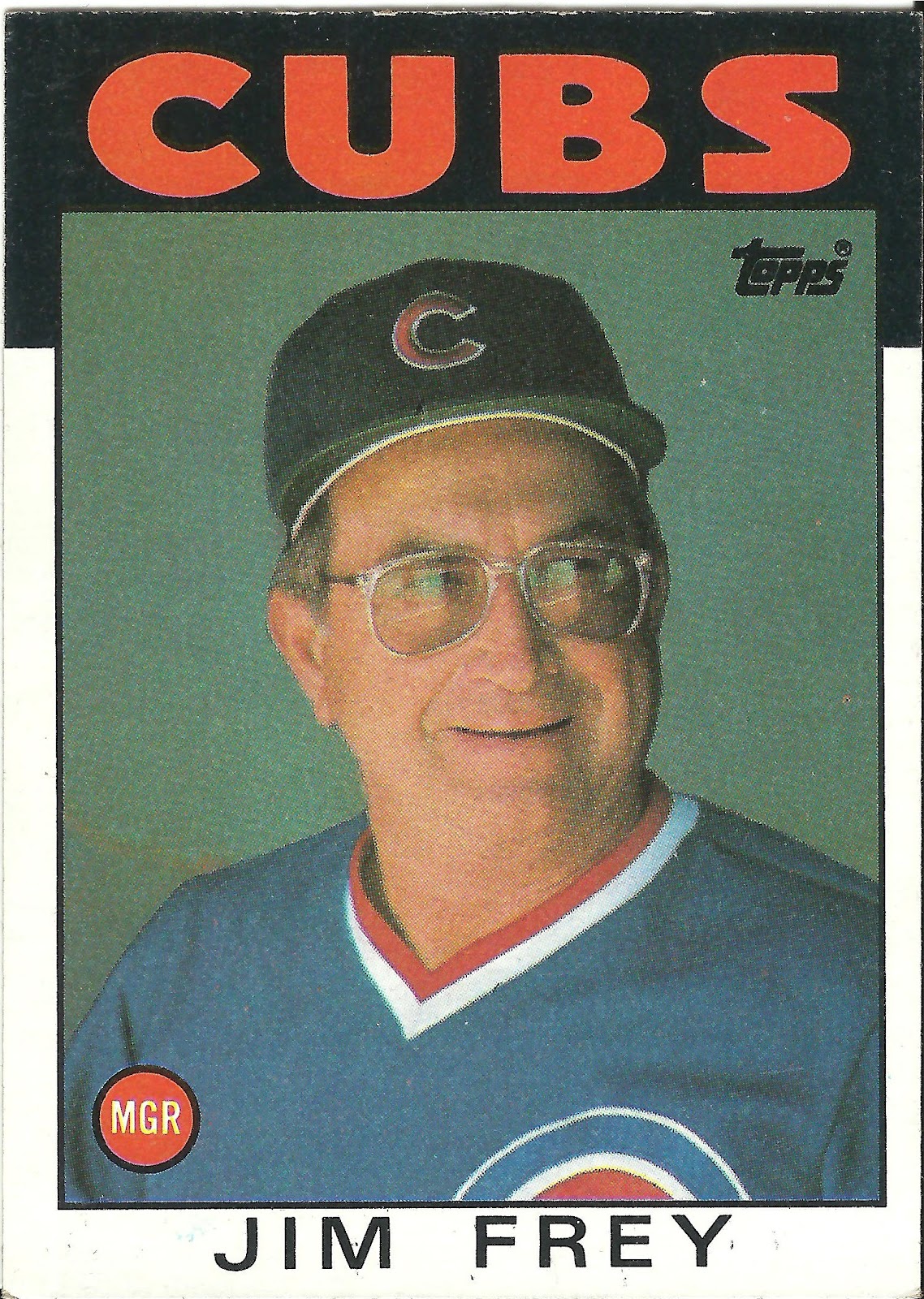
#231 Jim Frey


Card thoughts: Because this picture is taken in the dark with a green background, it's making the blues look all messed up.

The player/manager: With Frey, there is no major league career to speak of. After toiling in the minors for the Cardinals, Dodgers, Prates and Braves systems. Frey never got a shot at the majors until he was hired by the famed Earl Weaver to be on his coaching staff in the 70s.

Frey was a manager who always performed spectacularly for a team when first hired (both the Royals and Cubs went to the playoffs in his first year of managing them) before their records tailed off. After coaxing 97 wins out of the Royals in 1980, Frey’s 1981 edition fell flat on his face, and he was fired before the end of the season in favor of #199 Dick Howser. After two years of exile as a coach for the lowly Mets, Frey replaced the mercurial Lee Elia as the Cubs manager. He led the team to the post season for the first time in nearly 40 years and was named Manager of the Year. But he mishandled the pitching staff in the playoffs, and the Cubs didn’t make it to the World Series, despite being up 2-0 in a five game series.

Injuries bedeviled the Cubs in 1985 when their entire rotation went down at once due to injury (either it was a freakish coincidence or Frey was also mishandling his pitchers during the previous regular season as well). Frey was finally fired by the Cubs during the 1987 season, replaced by non-entity Jim Essian.

Frey spent one year as a color commentator for the Cubs on the radio, and them moved into the front offices as GM, replacing the man who had hired him, Dallas Green. There, he made a bunch of terrible deals. A terrifically poor evaluator of talent, he traded Keith Moreland for a washed up Goose Gossage; believed that Lee Smith was going downhill (he saved about 200 more games after the trade) and got back busts #181 Al Nipper and #210 Calvin Schiraldi; signed Dave Smith, Danny Jackson, and George Bell to lucrative free agent contracts long after they were in their primes; and even in the good trade he made (Rafael Palmeiro and Jamie Moyer for Mitch Williams), he ended up choosing two future stars to send, rather than some non-entities.

Frey left the GM spot in 1991 and currently is the vice chairman of an independent league team.


Rear guard: There's no real glaring omissions on the position player side. However, one of these three pitchers should have been issued a card: Jay Baller, Steve Engel, or Ron Meridith. Meridith got a Donruss and Fleer card. 


This date in baseball history: The Senators steal 8 bases off of the Indians in the first inning of a game in 1915, establishing a record.

Monday, February 20, 2012

#171 Bob Rodgers


Card thoughts: Rodgers was generally known as “Buck,” but was never so named on any of his cards. The perspective of this card makes the bat Rodgers is holding look like a toy. Question: Does Topps use prop bats in some of it’s photos?

The player/manager: Buck Rodgers was fine defensive catcher who was strong in the clutch, but didn’t hit for a high average. His best season in his 9 seasons with the Angels was his first full season when he caught 150 games (a rookie record), hit 34 doubles, drove in 61, and hit .258. This was enough for Topps to give Rodgers an all star rookie card.

Immediately after retiring a player, Rodgers was hired by his former (and only) big league manager Bill Rigney as one of his coaches on the Twins. He remained in that role until 1974, and later coached the Giants (1976) and the Brewers (1978-80). Rodgers finally got his first chance as a major league manager with the Brewers when #21 George Bamberger had a heart attack near the beginning of the 1980 season. Bamberger attempted to come back, but left again before the end of the season, so Rodgers managed two different times in one season: He went 27-21 the first time around and then 13-10 the second. Rodgers managed the team full time in 1981, but the Brewers started slow in 1982, and he was replaced by Harvey Kuenn. Of course, that team would go to World Series as “Harvey’s Wallbangers.”

He next had a much longer run as the Expos manager from 1985 to 1991. Rodgers only finished below .500 one season of all the full seasons he managed north of the border, and he even won a career high 91 games in 1987 (for which he won Manager of the Year honors).

Rodgers finished his managerial career with his original team, the Angels, who he managed from 1991 to 1994. Another freak experience happened to him during this tenure. The Angels team bus was involved in an accident, and Rodgers was seriously injured, breaking his knee, his elbow, and a rib. He was confined to wheelchair for most of the season, with coach #128 John Wathan, taking over in midseason.

Rodgers finished his managerial career with a 784-774 record, a .503 winning percentage. He only made the playoffs once (in the split season of 1981) where his Brewers lost to the Yankees.


Rear guard: You can see there's another manager card error. Two managers share card #141: The other is Chuck Cottier. No glaring missing players, although in hindsight Andres Galarraga should have been chosen as the rookie representative, as he had more at bats than #131 Razor Shines. The lack of Miguel Dilone card, who played 51 games with the Expos before being released, will be discussed when the Padres manager card comes up.

Saturday, January 7, 2012

#141 Chuck Cottier


Card thoughts: Cottier looks like a off-duty steel worker, ponying up to to his local dive bar. The second manager card of this set where the manager seems caught in mid-lecture.

The manager:  As a player, Cottier was a poor hitting, good fielding, middle infielder who played from 1959-1969 on the Braves, Tigers, Senators, and Angels. After a year off, he began his managing career in the Pirates and Angels minor league systems. Cottier finally made it to the majors (again) as a coach for the Mets from 1979 to 1981. He moved on to coach the Mariners, and then took over for Del Crandall after he was fired with 27 games left in the 1984 season. He led the team to 15-12 record as an interim manager, which was good enough to be hired full-time in 1985, the season shown on this card. In his only full season as a manager, he led a Mariners team with a good lineup but terrible pitching staff to a 6th place finish and a 74-88 record. In one memorable moment that season, Cottier became enraged at a check swing strike call, pushed #70 Dave Winfield off of first base, and hurled the bag into the outfield. He later threw an equipment bag and a bunch of bats onto the field.

Cottier was fired the following season after the Mariners got off to a slow 9-19 start. He later went on to coach for several seasons for the Cubs (which I kind of remember), and for the Orioles (1995) and Phillies (1997-2000).


Rear guard: On the hitting side, it is a shame they picked Darnell Coles rather than Danny Tartabull to represent a late season call-up . The omission on the pitching side is pitcher Salome Barojas, who pitched more innings than Mike Morgan, #61 Karl Best, and Brian Snyder.

Tuesday, November 8, 2011

#111 Roger Craig


Card thoughts: I remember when I kept hearing about this San Francisco sports figure in the news. Turns out it was this guy. Not much to say about this photo, other than if you look at Roger Craig cards from the 60s, he pretty much looks like this. Must be the distinctive nose.

The manager: Craig was your classic swing pitcher, when that was still a common position on a staff. He generally pitched about half of his games as a reliever and half as a starter. He had one incredible year in this role, leading the league in shutouts in 1959 and sporting a miniscule 2.06 ERA. Unfortunately, as a player Craig is best remembered as one of the worst pitchers on the original Mets teams, leading the league in losses in both 1962 (24) and 1963 (22).

After his playing days were over, Craig became a well-regarded pitching coach. In fact, he is one of the fathers of the split finger fastball, having taught it to many of his pitchers. In 1978, he was finally given a shot to manage the Padres. He led them to an above .500 finish the first year, but in 1979, the team won 16 less games, and his contract was not renewed. He returned to his role as a pitching coach for the Tigers, including their World Series winning year of 1984. He was working in Tigers minor league system when he was hired to replace Jim Davenport for the last 18 games of the 1986 season. He was very successful as a Giants manager; all of his teams were over .500 until 1991. He won the division in 1987 and the pennant in 1989, losing the infamous "earthquake" World Series in the latter year against the A's. Craig is known for the expression "hum baby" which he applied to grinders, like third-string catcher Brad Gulden. I've never heard this phrase, but Giants fans seem to recall the phrase fondly.


Rear guard: The major omission here is Gary Rajsich, who batted 91 times for the Giants. However, he was traded to the Cardinals mid-season (although he never made it back to the majors). Perhaps Topps was waiting for him to appear in a Cardinal uniform.

Monday, September 5, 2011

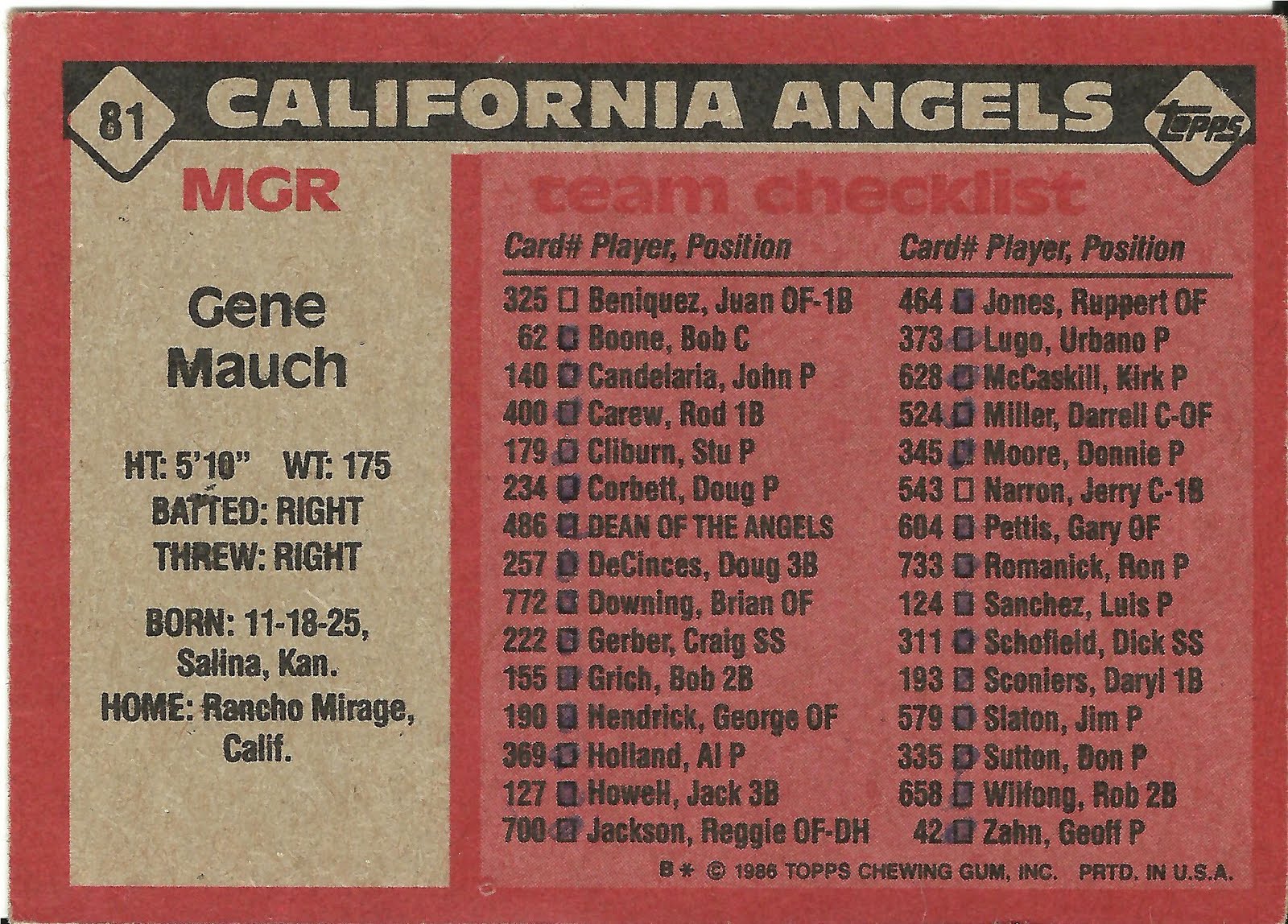
#81 Gene Mauch


Card thoughts: It may be my imagination, but I seem to recall there being a lot of crusty looking managers in 1985 who had managed for decades. They seemed recycle known quantities much more back then. This was Mauch's 25th year as manager.

The manager: Mauch was a reserve middle infielder with little power for 6 teams over 9 seasons, batting a measly .239. As a manager, in the 27 years he managed, Mauch only had two seasons when he did not manage in the majors from 1960-1987. He was a practitioner of "small ball" and loved riding the opposing players and umpires from the bench. He started by managing the Phillies for most of the 60s, garnering a .486 winning percentage. He was present for the epic collapse by the Phillies in 1964 when, up by 6 1/2 with 12 games to play, the Phillies missed winning the pennant by 2 games. The cause was his decision to ride his two aces, Jim Bunning and Chris Short too hard. Previous to this, in his second year managing the Phillies they lost 23 games in a row.

The Expos must have liked what they saw of Mauch, as he was the first manager in franchise history. Perhaps the 20 losses in a row by Expos in 1969 can be attributed to that, or perhaps Mauch was truly "ill-fated," as many believed. After 7 seasons with the Expos, none above .500, he was hired by the Twins and managed some good teams for them in the late 70s. 3 out 5 of his teams were above .500. Mauch would have his greatest success as the manager from the Angels. But he never won a pennant with them either, despite being one game away in 1982, and one strike away in 1986. The Angels were the only team he would manage to a cumulative record of over .500. He reportedly had to quit because he was chain smoking so much as a manager it was affecting his health. He eventually died of lung cancer in 2005.


Rear guard: I only needed Jerry Narron and Juan Beniquez to complete the Angels! Of course, the great omission here is Mike Witt, the top pitcher for the Angels in 1985 of whom I had no idea until I was surprised by his existence in the 1986 ALCS. I have no idea why Mike Witt's card was missing for this year, but not in 1985 or 1987. If any one knows, please comment!

Sunday, June 19, 2011

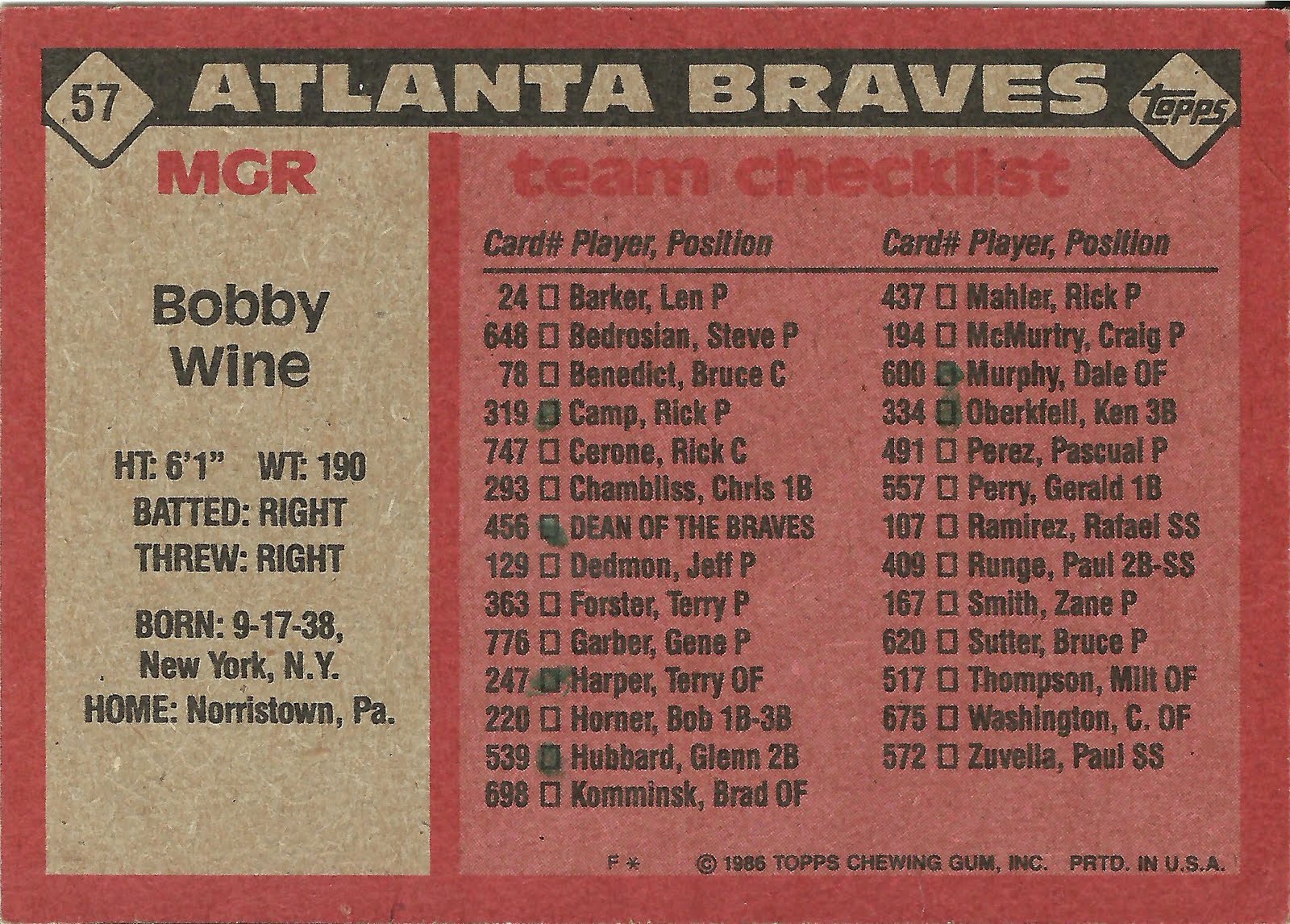
#51 Bobby Wine


Card thoughts: There were a lot of pictures taken in his spring training park. Wine looks a little overdressed in this picture, and the odd shadows on his uniform makes it look like he's sweating in some very strange places.

The player: As a player, Wine was a good fielding, light hitting shortstop with a career batting average of .215 over 12 seasons. Immediately after his playing career in ended early in the 1972 season, he became a coach with the Phillies. He would stay as a coach in that organization until 1983. After a year away from the coaching box, he would become the third-base coach for the Braves during the year shown on this card. He became the interim manager on August 26 when the Braves fired Eddie Haas. He went 16-25 the rest of the season and would never manage again. In later years, he would become a coach for the Braves (again) from 1989-1990 and the Mets from 1993 to 1996. His son Robbie Wine is a former major league catcher.


Rear guard: This card has an error. Someone must have sloppily written 51, so the printer thought it read 57. There's a few glaring omissions on the cards Topps chose to print of Braves players. Joe Johnson, who started 14 games was not given a card and neither was Steve Shields, who pitched 68 innings in relief and started 6 games. I must have gotten this card early in the collecting year: Only 6 Braves players are checked off.

Tuesday, April 26, 2011

#21 George Bamberger


Card fact: Like a lot of managers, George Bamberger was a marginal player. He would have many more cards as a manager (and a coach, in the days they were shown on cards) than as a player.

Card thoughts: This picture was taken during spring training, as the manager is sitting on a folding chair outside the dugout. Kind of an odd shot, as Bamberger is looking sidelong at the camera.

The manager:  Bamberger gained fame by being Earl Weaver's pitching coach in the late 60s and early 70s when the Orioles had the best pitching staff in baseball. This was the second stint for Bamberger as the manager for the Brewers. During his first go-round, he had a 235-180 record from 1978-1980. In 1980, he had a heart attack during spring training and didn't join the team until June 6. However, he couldn't finish the season and coach Bob "Buck" Rodgers, who started the season managing the team also finished the season at the helm. He wasn't done, however, and after two dismal years with the Mets (1982-1983), he came back to manage the Brewers. Unfortunately, even though he had many of the same players as in his first stint (Cecil Cooper, Ben Ogilve, Jim Gantner, Pete Vukovich, Charlie Moore etc), those players were mostly in decline and on the year shown on this card the Brewers lost 90 games. The next year he was fired in September and replaced by Tom Trebelhorn.


Rear guard: Good coverage of cards from this team, with no glaring omissions. However, Chuck Porter was injured most of the year. Could have replaced him with pitcher Tim Leary (a rookie) or outfielder Doug Loman.