Showing posts with label Rangers. Show all posts

Saturday, February 15, 2014

#397 Steve Buechele


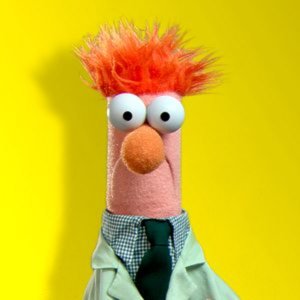
Card thoughts: I always thought Buechele had a weird body. Perhaps it was his oval like head combined with a lack of shoulder breadth that made me think of Beaker. Oh, and for a time he also sported the dreaded flowing curly-haired mullet, the most offensive of all mullets.

The player: Buechele was a third baseman known more for his solid defense than his offense. Despite playing the majority of his career in hitter friendly ball parks, he never slugged better than .450, a low average for what should be a power position.

A college roommate of John Elway at Stanford, Buechele was drafted in the 5th round by the Rangers and immediately assigned to AA Tulsa where he hit .296 in 60 games. Mainly a second baseman in the minors, Buechele was shifted to third in 1985 to get him to the majors quicker (veteran Toby Harrah was manning second, and #285 Buddy Bell was about to be traded to the Reds).

Once Bell was traded on July 19th, Buchele had the unenviable task of replacing one of the all time greatest fielding third basemen. While Buechele held his own at third (he certainly was fielding better than the aging Bell), his average of .219 no doubt fueled many a fans lament at the loss of the popular Bell.

Luckily, Buechele began to hit better the following season. Although his average remained consistently low (he never hit above .250 in any of his full seasons with the Rangers), his fielding at third generally made up for his offensive short comings. Before he left the Rangers in 1991, Buechele would lead the league in range factor twice, and fielding percentage one. In fact, his .991 fielding percentage in 1991 at third base is a record at the position.

But in a midst of a career year in 1991 (18 home runs, 66 RBIs. .783 OPS), the Rangers decided it was best to shop him at the top of his game. So he was sent to the Pirates in a deadline move for former #1 draft pick Kurt Miller (the #24 prospect in baseball). While he was an improvement over the yearlong revolving door at third (John Wehner, Jeff King, and Bobby Bonilla all started a lot of games there), he hit just .246 the rest of the season, and .249 the first part of the next one.

With Buechele’s range and fielding affected by the faster artificial turf, he just wasn’t the same player as he was with Texas. Finally, with the Pirates deciding to go with Jeff King full time at third, Buechele was dealt to the Cubs for free agent bust Danny Jackson. I was excited with the arrival of Buechele, as the Cubs finally had a legit third baseman that they had lacked since the departure of Ron Cey.

But Buechele was the wrong side of thirty, and while he didn’t embarrass himself in his four seasons with the team, his 31 home runs in 1144 Cub at bats are pretty poor for a team that plays 81 games a year in a hitter friendly park. Eventually, with Buechele hitting just .189 by July 4th in 1995, he was released, catching on for a few last games with the Rangers a few days later.

Buechele currently manages the Rangers' AAA franchise in Round Rock, Texas.


Rear guard: Jim Bibby is better known as a Pirate. At age 28, 1973 was his first full year in the majors. After starting the year with the Cardinals, he was dealt to the Rangers on June 6. He later came within one hit of pitching a perfect game against the Braves in 1981 (the only hit came from the leadoff hitter, Terry Harper. Bibby retired the next 27 batters in succession). Here's his 1974 card.

Monday, January 27, 2014

#388 Dickie Noles


Card thoughts: That is one unfortunate nickname. It is very rarely used today. Also, almost every picture of Noles in the early days shows him with that enormous wad of chaw in his cheek.

The player: Legendary hothead Dickie Noles was known for a fierce fastball (topping 90 with regularity) and fierce demeanor on the mound (he was a legendary headhunter). He was the Carlos Zambrano equivalent for the Cubs in the early 80s. But his early promise never really translated into success, as his problems with alcohol and anger doomed him to a life as a marginal pitcher.

Noles reputation as a no-holds-barred pitcher came early. As a minor leaguer for the Phillies in the late 70s, he led the league in hit batters in the Western Carolina League, the Carolina League, and the Eastern League. Despite the wildness, no one could deny that Noles had a great arm, and he when he was called up in July of 1979, he was effective as a starter. In 14 starts, he kept the wildness in check (38 walks, 2 wild pitches, and 2 hit batters in 90 innings). However, he didn’t have the ability to go deep into games, so in 1980, he was shifted to the bullpen. Although Noles’ walks per nine innings went up, he did save 6 games. In perhaps his most memorable appearance in the majors, he relieved struggling starter Larry Christensen in Game 1 of the World Series that year in the first inning, and proceeded to shut down the Royals for the next four innings. What he is most remembered for, however, is throwing a little chin music to #300 George Brett (at 1:06:08 in this video). This pitch is credited with shutting Brett down for the rest of the series.

When Noles manager in that series, Dallas Green, became the GM of the Cubs, he began a wholesale pilfering of the Phillies young players, and Noles came to the team, along with #266 Keith Moreland, for Mike Krukow in 1982. Noles was again tries as a starter for the Cubs, and he went 10-13 that season, but with a high 4.42 ERA. His pitching wasn’t helped by his alcoholism, which led to him getting into several drunken brawls. The most infamous of these came at the beginning of the 1983 season, when he pummeled a cop trying to break up a fight at a bar where Noles was drinking. He was sentenced to 16 days in a Civil War-era Cincinnati prison, and later entered rehab. The season was a wash as well, as Noles suffered through a 5-10 season as both his strikeouts, and walks, went down.  Part of the problem was that in the fight he injured his knee, robbing him of his great fastball.

With a 2-2 record and a 5.15 ERA, Noles was the proverbial last man out of the bullpen in early 1984, before the Cubs finally tired of waiting for him to regain his fastball. He was shipped to the Rangers for two forgotten minor leaguers in July, where he failed to right the ship.

Tried again as a starter in 1985, his 5.54 ERA in the rotation hastened him into the bullpen by the end of the season, where he was marginally more effective. While Noles still had the great arm, some of his mound fierceness had left him once he quit drinking. While not as wild, he wasn’t striking out many either, and these traits made it hard to stick with any one club for very long. With the Indians in 1986, he was in the bullpen again, but he struck out barely more than he walked, so he was on the move again, this time back to the Cubs. Here, he would have his last effective season, going 4-2 with a 3.50 ERA. In a strange twist, Noles was sent to the Tigers in late September for a player to be named later, who turned out to be Noles himself, when no player was agreed upon (his card that year reads "Now with Tigers"). Which really didn’t make much of a difference, as he was granted free agency and later signed with the Orioles.

Noles would pitch just three more games after the 1987 season. He later became a born-again Christian, and spends much of his time giving anti-alcohol abuse lectures, using his own travails as an example. Noles also serves in the Phillies front office as the employee assistance professional, a kind of counselor to players battling stress, addiction, or mental illness.


Rear guard: Much has been written about David Clyde, mostly as a cautionary tale not to rush young pitchers into the majors. Basically, the Rangers needed an attendance boost, and the owner was the kind of idiot who would permanently damage a young player's arm to get it. Clyde had graduated from high school just 20 days before his debut, where he gave up just 2 runs in 5 innings, despite walking 7 (he also struck out 8). It was planned that he'd just make a few starts before being sent back to the minors, but he was kept in the rotation the rest of the season, which eventually ruined his arm. Here's his card from that season, one of only three issued by Topps in his all too brief career.

Saturday, November 2, 2013

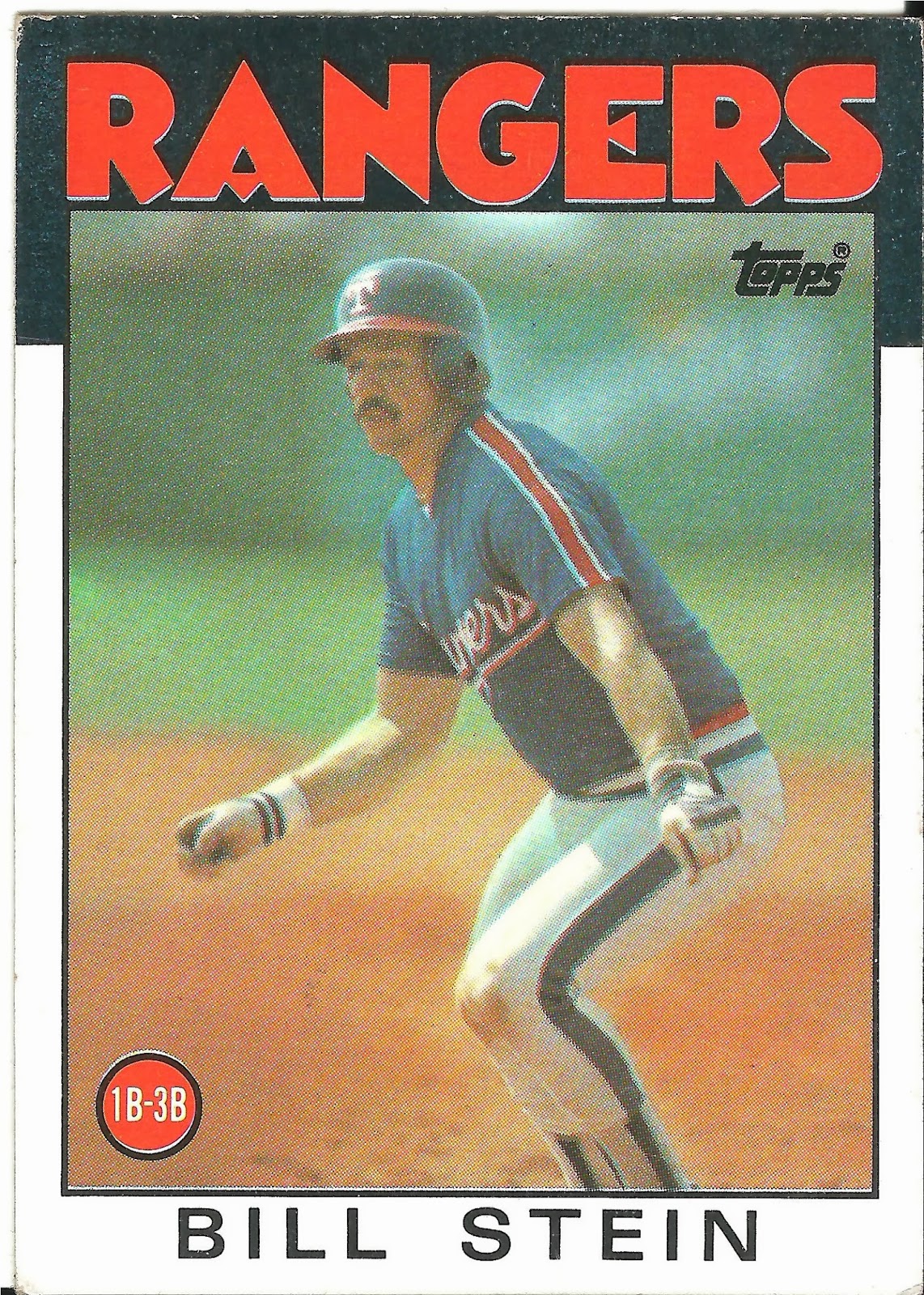
#371 Bill Stein


Card thoughts: Stein is doing the ever popular “basepath” surf. This would be his last card.

The player: Stein was pretty much a professional utility man upon his arrival in the majors in 1972. His only years as a regular came after the Mariners drafted him in the 1976 Expansion Draft.

Stein was originally signed by the nearby Cardinals out of Southern Illinois University, which was at that time a bit of a baseball powerhouse. As a college draftee, he was assigned to AAA Tulsa originally, and hit well there. But he was a man without a position. Although he could adequately play all the infield and outfield positions, he didn’t defend at any of them particularly well. This meant he was mostly stuck at AA and AAA until 1975, despite averaging a .295 average.

After a trade to the White Sox (via the Angels), Stein had his best season AAA, leading the league in hits, and hitting for power (.505 slugging percentage) for the first time. This earned him a permanent roster spot in 1975, and he even got a chance to play regularly at third (his best position) for a time when incumbent Bill Melton stopped hitting. But for the Sox his real value was a utility man, and he played all the infield positions and right field during the season.

Left exposed after the ’76 season, Stein was drafted by the Mariners, and he would turn in his finest major league season in 1977 as their regular third baseman, hitting 13 home runs and driving in 67. Twice during the season, he hit two homers in a game. Even his defense improved: His 146 putouts were tops among third basemen.

Unfortunately, this convinced the Mariners they had a solid third baseman for the next few years. They signed Stein to a three-year contract in 1978, but he would never approach those 1977 numbers again. A bruised hand sapped some of Stein’s power and defense, and he would lead third basemen in errors with 25, despite playing in only 111 games at the position (an abysmal .929 fielding percentage). The following year, he was injured much of the season, and his starting role was taken by Dan Meyer. So Stein went back to his old role as utility player.

While Stein still could hit, his lack of defense limited his utility. After a trade to the Rangers in 1981, he began to spend more time as a designated hitter and pinch hitter. Almost immediately he made his presence known, recording a record 7 pinch hits in row. For the year, Stein would hit a career high .330.

Stein would continue to excel off the bench, swatting .363 as a pinch hitter in 1982, driving in 7 runs that year, and the next. He was aging fast, however, and he only played in 27 games in 1984 as he nursed a wrist injury. The Rangers attempted to trade him after the season, but a physical showed a back problem, which invalidated a trade to the Pirates. Most believed that this spelled the end of Stein’s career, but with judicial use by manager Bobby Valentine, he managed to hit over .400 in a pinch hitting role.

The Rangers elected not to re-sign Stein after the season, and he retired. After retirement, he coached high school baseball for a season, and later spent time managing in the Mets and Giants systems. His career pinch hitting average was .282, with 2 home runs and 28 runs batted in.


Rear guard: In BIll Stein's final game, played this season, he struck out as a pinch hitter for Steve Buechele.

Monday, April 22, 2013

#328 Pete O'Brien


Card thoughts: Second infield fielding card in a row! O’Brien appears to have a wrist injury on his left hand.

The player: O’Brien won the starting first base job with the Rangers due to his fielding prowess. He had great range at first, which allowed him to lead the league in assists twice. Only later did he become a solid hitter.

O’Brien had an orderly march to the majors, spending a year at each level (Rookie, A, AA, AAA) before reaching the majors for good in 1983. The power he showed in the minors deserted him that year, and he slugged just .347. But by the time this card was issued, O’Brien was putting up numbers similar to his minor league ones. In 1985, he hit 22 home runs and drove in 92 with a career high 34 doubles, good for a .452 slugging percentage. What always made O’Brien even more dangerous was his eye at the plate: After 1984, he rarely struck out more than he walked. In any other year, this would have given O’Brien a shot at the all star game, but he had the misfortune of playing against #30 Eddie Murray and #180 Don Mattingly that year, which somewhat obscured his accomplishments.

Solid years in 1986 (23 HR, 90 RBI, .854 OPS) and 1987 (23 HR, 88 RBI, .805 OPS) did little to elevate O’Brien to the level of elite first basemen in the public’s mind. It didn’t help matters much that back then the Rangers were a generally miserable team. After another season, O’Brien was traded in a big deal that included disappointing former prospects Jerry Browne and Oddibe McDowell to the Indians, for Julio Franco, who would go one to have several great years with the Rangers. Browne would somewhat fulfill his promise with the Indians, but McDowell wouldn’t even last the 1989 season. O’Brien would contribute not much better than average numbers offensively, although he did reach the top ten in walks (83). The problem was that he was getting pitched around a lot as the guy who hit ahead of him most of the year (Cory Snyder) wasn’t doing jack with the bat.

Missing the RBI opportunities that were so plentiful in the dry Dallas air, O’Brien opted for a similarly offense friendly the park, the Kingdome, in 1990.  The first year there didn’t go so well, as O’Brien was injured in early May. The problem was a broken left thumb, suffered in a game against the Angels. He came back in June, but never got it going offensively, driving a career low 27 runs as a starter, and never getting his average above .250.

1991 saw O’Brien return to form (17 HR, 88 RBI) but it would be his last good season.  He hit .222 the next year, and appeared in just 72 games in 1993, his final season. O’Brien gave up a year’s salary to retire, saying his family and God were more important than an extra two million in cash.

It is unclear whether Pete O’Brien ever entered the ministry, as he had intended after retiring. Perhaps his spiritual quest took a more new-age direction. He and his wife currently operate a relaxation spa outside of Dallas that offers floatation therapy, among other things.


Rear guard: Here's his first card. Pretty squinty. O'Brien was hitting second when he launched a solo shot off of Hall of Famer Gaylord Perry for his first home run.

What a last name for Bill! I wonder if they called him "Goggles." He went 4-11 in 1972, although he game up less than a hit per inning. Here's his card from that season. Gogolewski looks sad.

Sunday, January 13, 2013

#296 Geno Petralli


Card thoughts: You are looking at the lost Marx Brother. Geno joined Zeppo,  Harpo, Chico, and Groucho in that classic comedy “Ball Five.” This was Petralli’s first Topps card. He appeared on a Fleer and Donruss card in 1983 as a member of the Blue Jays.

The player:  Petralli started out in the Blue Jays system, but he struggled to get playing time in the minors. As would be a pattern for Petralli in his career, he was frequently used as a backup for other catching prospects. But Petralli got the last laugh as Dan Whitmer, Ramon Lora, Juan Espino, and Kevin Buckley made little to no impact on the majors.

Petralli finally made the team out of spring training in 1984, but he didn’t get much of a chance to play as the Blue Jays had Ernie Whitt and Buck Martinez on the roster as well. He was sold to the Indians in May, and barely played for their AAA club. The next season he once again struggled to get playing time, and Indians released him in May.

This was a stroke of luck for Petralli, especially after the Rangers signed him.  Starting catcher Don Slaught was injured two months later, and Petralli was brought up to share the position with Glenn Brummer. When Slaught came back, Petralli remained on the roster, playing in what was then a career high 42 games.

With Brummer released at the end of 1985, Petralli became the primary backup for Slaught. However in this season there were four catchers on the roster, so he got more playing time moving around the field, spending time at catcher, third base, second base, and designated hitter.  With Don Slaught’s departure in 1986, Petralli became the Rangers starting catcher until 1991. Especially productive for him were the 1987-1989 seasons. For those three years, he never saw his batting average go below .280 and he set career highs in just about every offensive category.

It was during this time period that Petralli was chosen to be knuckleballer #275 Charlie Hough’s personal catcher, and honor that reflected his great fielding ability. That wasn’t enough to stop him from setting a modern day record with 35 passed balls.

Although he caught a career high 118 games in 1990, the increased playing time might have overexposed Petralli to the league, as he drove in only 21 runs and hit .255. He did catch #100 Nolan Ryan’s 300th win, however.  The next season he started the season as the primary catcher, but a back injury sidelined him, paving the way for the arrival of Ivan Rodriguez, who would start at catcher for the next 12 years. Petralli would backup Rodriguez for the next couple of years, but we all know how durable “Pudge” was behind the plate, so Petralli had few chances to play.

Signing with the Cubs in 1993, Petralli was a player-coach for AA Orlando, but an injury caused his retirement later that season.

One of Petralli’s sons plays independent ball (yawn), but the other plays independent music in well-regarded, Pitchfork approved band, White Denim. Just a guess: The hearse driver in this video is young Petralli. My friend Korry once saw them at a backyard party at SXSW in Austin, Texas and said they were killer.


Rear guard: Petralli's first hit was a double to left off Indians pitcher #24 Len Barker. He later added a single and sacrifice hit.

Dave Nelson was the color man on WGN broadcasts for a few years in the 1980s, and he was really terrible. He was a fast guy, but only had a couple of seasons where he topped 30 steals. Although he stole 25 bases in 1974, he was caught 13 times, making him not really that effective stealing bases. Here's the card representing that season.

Thursday, November 15, 2012

#275 Charlie Hough


Card thoughts: Why is the camera so far away from Hough? You can barely make him out against that Mondrian background.


The player: This post is appropriate as Hough, like today’s Cy Young Award winner R.A. Dickey, used the knuckleball as his out pitch. His greatest success came after the age of 34 when (like Dickey) he was converted to a starting pitcher by the Rangers.

The knuckleball was learned by Hough as a matter of necessity as he hurt his shoulder in the minors, but didn’t want to tell the Dodgers for fear they would release him. Tommy Lasorda taught him the pitch, and the first year he used it in AAA, he would have won the ERA title had he had enough innings. However, he had difficulty controlling it, while caused the team’s catchers to allow 52 passed balls when Hough pitched.

Hough finally learned to control the pitch when legendary pitcher Hoyt Wilhelm was signed, and taught him how to control the pitch while pitching beside him in the minors.

Hough spent almost a decade as a middle reliever/long man for the Dodgers, becoming the closer in 1976 (12-6, 18 saves) and 1977 (6-12, 22 saves). Unlike relievers today, Hough often pitched over 100 innings in relief, with the knuckleball, a pitch that does not contribute to much wear on the arm, allowing him to bounce back with more minimal rest than other pitchers.

After the 1977 season, Hough’s ERA climbed each season before a 5.57 mark to start 1980 convinced the Dodgers to sell him to the Rangers. After a slow start to his Rangers career, he was converted to a full-time starter in 1982, and immediately responded, going 16-13 and completing 12 games.

For the rest of his Rangers career, Hough would win, and lose, in double digits, his record generally being just above or below .500. What he did do was provide the Rangers with an innings eater on a staff that turned over a lot every year. His two best seasons with the Rangers would be 1984, when Hough would lead the league in games started and complete games while going 16-14, and 1987, when he would start a league leading 40 games, pitch a league high 285 1/3 innings, and win a career high 18 games.

At age 43, still a league average pitcher, Hough signed with the White Sox, where he found middling success as age began to catch up to him. At one point in 1991, he found himself pitching to another 43-year old, Carlton Fisk, behind the plate.

In the expansion draft in 1993, Hough was chosen by the Florida Marlins. He pitched the first inning in Marlins history, but the season was not a happy one for Hough as he went 9-16 with a 4.27 ERA. He finally retired at age 46 after 25 years in the bigs following the 1994 season.

Hough is the all-time Rangers leader in wins, losses, complete games, and strikeouts. Lots of “lasts”: He was the last player born in the 1940s to play in the majors and was the oldest in the league in 1993 and 1994. Hough has an even .500 record in his career, 218-218, and was the last pitcher to start 40 games and pitch 13 innings in a game. Hough is also the last pitcher to start over 400 and relieve over 400 games.

Two great quotes from Hough:

"A good knuckleball is one the catcher successfully blocks"
"I throw ninety percent knuckleballs. The other ten percent are prayers. I probably could throw other pitches. The only reason I don't is that I love pitching in the major leagues."

Since retirement, Hough has been the pitching coach for the Dodgers (1998-1999) and the Mets (2001-2002). He is currently working in the Dodgers front office as an adviser.

  
Rear guard: Here's Hough's rookie card. He was an old, young man. As for the other rookies on the card, Bob O'Brien pitched 14 games (4 starts) in 1971, his only season, and went 2-2 with a 3.00 ERA. Mike Strahler actually pitched 53 games over 4 seasons with the Dodgers and Tigers. His career record was 6-8.