Showing posts with label Pirates. Show all posts

Saturday, August 16, 2014

#425 Larry McWilliams


Card thoughts: Topps did a good job capturing what made McWilliams effective: A deceptive delivery.

The player: McWilliams was the Braves’ #1 draft pick in 1974 (in January—there used to be two drafts a year). Most of the guys in that draft didn't make it to the majors, and Roy Smalley was the only player better than McWilliams that was chosen.

A starter for the first part of his career, McWilliams 9-3 record as a rookie (with a 2.82 ERA) showed promise. In addition, he was one of the pitchers that stopped Pete Rose's 44 game hitting streak that year. But he would struggle as a starter as he made just 13 starts in 1979 while getting injured, and when healthy in 1980, went 9-14. Seemingly in desperation, he went to a quick no wind-up, pitching motion that served to make hitters uncomfortable at the plate. This made McWilliams’ forkball even more devastating, although it wasn't until a trade to the Pirates that it began to show.

After year in 1981 that he spent almost entirely at AAA (he made just 5 starts), McWilliams began the year with the Braves, but as a reliever, rather than a starter. His 6.21 ERA was the highest in his career, so the Braves gave up on him, shipping him to the Pirates for Pascual Perez.

With the Pirates, McWilliams had a great season as a starter, going 6-5 with a 3.11 ERA. The next year, his 15 wins were sixth in the league, and that year he was in the top ten in many other pitching categories as well. McWilliams last year as a full time starter was 1984, where his numbers slipped to 12-11, more because of the poor play of the Pirates.


By the time this picture was taken, McWilliams was a swingman, starting only 2/3 of the games he pitched. He was less effective in this role, and his 3-11 record in 1986 (1-8 as a starter), told that tale. In 1987 he pitched so badly, he was a briefly out of baseball. But the Cardinals took a chance on him the following year, and he was a durable, if not spectacular, spot starter and long reliever for them. Another year followed with another abysmal winning percentage, this time for the Phillies (.154). McWilliams would end his career with the Royals in 1990 on May 12. He threw just one pitch in that game, and it was stroked for a RBI double by Lance Johnson.


Rear guard: McWilliams' first win came against the Mets in his major league debut. He gave up no runs, and five hits in 7 innings, walking 2 and striking out 2.

Saturday, June 28, 2014

#417 R.J. Reynolds


Card thoughts: One of a long line of product placements/ball players including Coco Crisp and Milton Bradley. His real first name is Robert.

The player: Reynolds broke in with the Dodgers at the end of the 1983 season, and a suicide squeeze in the bottom of the ninth helped the Dodgers win an important game against Atlanta. The next two seasons, Reynolds courted anonymity as a reserve outfielder. However, in a deal that helped both teams, the Pirates acquired him late in the 1985 season with Sid Bream and Cecil Espy for Bill Madlock.

Although still a reserve outfielder, Reynolds got a lot more playing time with the far inferior Pirates. He consistently got over 300 at bats from 1986-1989 and ended up playing in every game in the 1990 NLCS.

After that season, he went over to Japan and played for three seasons where he hit for good power Taiyo and Kinetsu. He never returned to the majors, and retired at age 34.


Rear guard: Reynolds' first hit was a three run homer as a pinch hitter off #15 Ed Whitson.

Glenn Wright drove in over 100 runs four times, but injuries affected his career, and he barely played after age 32.

Tuesday, January 14, 2014

#387 Steve Kemp


Card thoughts: Kemp generally looks a lot shaggier on his cards (see here, here, and here). This is Kemp’s only base card as a Pirate.

The player: Kemp had a charmed baseball life his first few years in the majors. A #1 vdraft pick out USC, he spent just one year in the minors before joining a very talented young Tiger team in 1977, which also included rookies #270 Jack Morris, Lance Parrish, #130 Alan Trammell, and #20 Lou Whitaker, all who made their debuts that season. Despite driving 88 runs as a rookie, Kemp did not rank in the Rookie of the Year voting, which was dominated by #30 Eddie Murray and Mitchell Page.

In his sophomore season, Kemp’s power numbers slumped a bit as he learned to be more selective. This would set him up for two monster seasons in 1979 and 1980.  In both seasons, Kemp drove in over 100 runs but the ’79 season really stood out, as he reached career highs in home runs (26), RBIs (105), batting average (.318), slugging (.543) and OPS (.941). Kemp made his only all-star squad that year, where he went hitless in a pinch hitting appearance for Bob Stanley. The one drawback in his game was fielding, as he was tentative in left field (although when he got to the ball, he didn’t generally flub it).

Unfortunately for the Tigers, all that success increased Kemp’s value. After turning down a $750,000 contract, the Tigers felt they were going to lose him to free agency after the 1981 season.  So they traded him to the White Sox, straight up, for another former all-star outfielder, #160 Chet Lemon. Kemp had mixed feelings about the trade, as he acknowledged he’d miss Detroit, despite being booed there often.

This trade would be beneficial to both clubs. Kemp would have one his finest years for the White Sox, scoring a career high 91 runs, and driving 98, despite hitting just 19 home runs in less hitter happy Comiskey Park.  But, like the Tigers, the White Sox couldn’t afford to pay the slugger $1 million a year. Instead, he left for the Yankees. At 28 years old, and one of the highest paid players in the league, the world was Kemp’s oyster.

Except, it wasn’t.  Kemp was one of the first free agents to get clubs to engage in a bidding war (the Orioles were miffed that Kemp’s agent was playing both sides against the middle. Ah, innocent times!), and the expectations for him in New York were sky high. But Kemp had been hit in the elbow at the end of the 1982 season, and he began overcompensating for the injury, which led to him pulling his groin after just one at bat in the first game of the 1983 season. He later badly bruised his collarbone after colliding with the outfield wall.  Kemp got into just 109 games and his OPS dropped .718.  His defense, always suspect, was even worse with the injuries, and he was booed lustily at home.

But it got even worse. He was struck in batting practice by a line drive at the end of the 1983 season, which broke his eye socket, and permanently damaged his optic nerve, leading to a blind spot and lack of depth perception. Kemp did hit for a higher average in 1984 (.291), but the power was gone, and with it, his position of one of the best hitters in the game.

Desperate to unload the damaged Kemp, the Yankees included a boatload of cash to the Pirates, as an encouragement to take him off their hands. With the Pirates, Kemp failed to provide the power they needed (13 doubles, 2 home runs) in 92 games, and he was released early in 1986 season, having never regained his power stroke (and once again, being booed constantly).

Kemp attempted comebacks with the Padres and the Rangers and, although he hit well at AAA, he only got 36 more major league at bats in 1988 before he retired.


Rear guard: Kemp's two home runs on August 19 came off Seattle pitchers Dick Pole and Diego Segui. The first one plated the first three runs of the game (Kemp, Rusty Staub, and Tito (not Puente) Fuentes.


Sunday, August 18, 2013

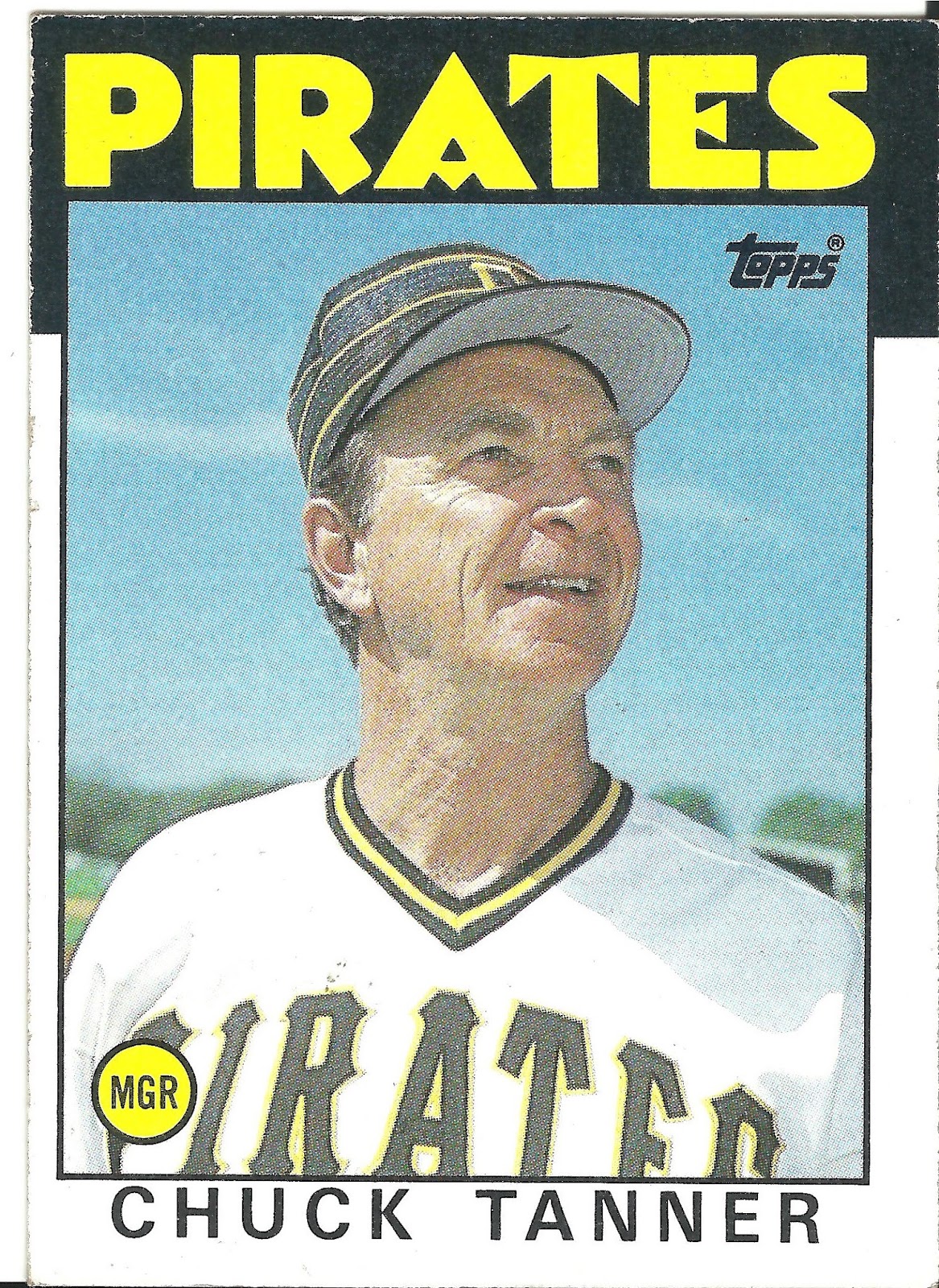
#351 Chuck Tanner


Card thoughts: Tanner is still all smiles, despite the fact that a) the once proud Pirates franchise was collapsing under a pile of cocaine b) the Pirates would finish in last place in 1985 and c) he was about to be fired.

The player/manager: Like many managers, Tanner had an unremarkable major league career. His career as a “regular” major leaguer lasted just three years (1956-1958), and his most successful years were with the Cubs as a fourth outfielder.  He managed for some time in the Angels chain before getting the chance to manage the White Sox in 1970. With the White Sox, he was able to bring out the best in the mercurial Dick Allen, leading to him winning the MVP in 1972. Other items of note during his White Sox tenure: He went with a three-man rotation in 1972 (the year he won the Manager of the Year award), and converted Rich Gossage and Terry Forster into dominant relievers.

By 1976, he was with the A’s where he developed a steal-at-all-costs strategy. In 1976, in the midst of Charlie Finley dismantling the former powerhouse, the A’s set a modern record with 341 steals (the stolen base was so paramount, the A’s employed two players—Larry Lintz and Matt Alexander—whose sole job was to pinch run). In an unusual move, Tanner was “traded” to the Pirates in the off season for Manny Sanguillen.

With the Pirates, Tanner had the most success, leading the team to a World Series win in 1979. That season, Tanner is credited with inventing modern bullpen usage, by designating relievers to come in one inning at a time after the sixth inning. But success faded fast, as several of his players (including the Pirates mascot!) were implicated in the Pittsburgh drug trials in 1985. By 1986, he was out.

After accepting the thankless task of managing, the creaky and dull 1986–1988 Braves teams, Tanner was replaced by Russ Nixon, thus ending his managerial career with a 1,352–1,381 won-loss record.

Tanner, and since his death, his family, run a restaurant in New Castle, Pennsylvania named "Chuck Tanner's Restaurant".


Rear guard: This is one of my best preserved cards in the set (and the back isn't marked up), which means I either got this card late in the year, or it was a substitute for a more beat up one. 

No glaring omissions on the Pirates cards chosen for this set. Outfielder Doug Frobel played 50 or so games for the Pirates, but he was sent to the Expos late in the year (and there isn't a card for him, even in an Expos uniform, in this set.)

Thursday, March 7, 2013

#316 Sammy Khalifa


Card thoughts: This is perfect shot of Khalifa leading off second at old Three Rivers Stadium. I don’t why Topps chose to shoot in these cookie cutter east coast stadia, but not at Fenway or Wrigley. This is his rookie card.

The player: Khalifa was one of the rare Muslims to play baseball. Despite being born in California, he learned to play baseball in Egypt and Libya as a child where his father, a petroleum engineer, worked as a consultant.

But it was as a star baseball player in Arizona that Khalifa attracted the scouts. He signed with the Pirates, who were entering a bad stretch by the 80s. Despite mediocre offensive numbers in the minors, Khalifa was a gifted shortstop in the field. He was promoted in June to start at short after veterans Tim Foli and #48 Bill Almon failed at the job. Despite hitting only .238, the Pirates were high on Khalifa.

However, the team was in transition. Manager Chuck Tanner was let go, new manager Jim Leyland was installed, and the team was for sale. A whole new crop of rookies, much more talented than the previous class, was arriving. Khalifa was platooned with Rafael Belliard, who turned out to be a much better player. Various members of the Pirates coaching staff felt Khalifa held more promise, but he didn’t have the mental drive to succeed.

Sent to the minors for much of the 1987 season, he found himself competing against future star Jay Bell for playing time. The final straw came when he missed the team bus by five minutes. Instead of catching up with the team, he flew home to Tuscon and was suspended. Khalifa was encouraged by his father to persevere and give baseball another shot. Unfortunately, in January of that off-season, his father was murdered. 

After being in a car accident, his father had regained his devout faith in Islam and became an imam, with several books to his credit, mostly trying to reconcile technology with his faith. Khalifa’s father was especially interested in numerology.
 His perceived apostasy brought him the unwanted attention of several terrorist groups. And for years it was thought they had killed him. But just recently, a man who had fled to Canada was convicted in the killing. This man had no known terrorist connections.

At any rate, the murder so traumatized Khalifa, he never played baseball again. He currently drives a cab.


Rear guard: I'm beginning to think that Topps uncovered a lot of these extremely trival "brother" facts when they were researching the Big League Brothers subset in the 70s. 

Howie Camnitz was a great pitcher for the Pirates, especially in 1909 when he went 25-6 with a 1.62 ERA. He had two other seasons where he won over 20, but he tailed off quickly when he turned 30, winning only 133 games in his career. His brother Harry pitched only one game in 1909, and two more in 1911 to finish out his major lreague career. However, he did win 27 games for the McKeesport Tubers in Class C Ohio-Pennsylvania League in the former season.

Saturday, December 29, 2012

#289 Johnnie LeMaster


Card thoughts: This picture looks like it could have been taken in 1910. LeMaster bears a striking resemblance to many of the players featured on the “Old Judge” Tobacco cards. LeMaster also hit like a shortstop in the teens. It is pretty lucky that Topps got him in a Pirates uni, as it was the third team he played for that season (all finished last).

The player: How does a player like LeMaster play for 12 years in the majors, many of them as a starter? He hit only .222 in his career (and got on base at a morbid .277 clip while “slugging” .289), and had many seasons when he barely hit .200, despite getting over 400 plate appearances. But in the pitching dominated late 60s/70s/early 80s, it wasn’t expected that shortstop produce much with the bat, only that he could make the plays. 

Some still believe Johnnie was one of the worst players ever. Conversely, there is a Giants site named "The Sons of Johnnie LeMaster."

LeMaster played 11 seasons for the Giants during their most fallow period ever, when it came to post-season appearances. His first plate appearance would fool Giants fans into thinking that this was an exciting player. LeMaster tied a major league record by hitting an inside the park home run in his first at bat.

After showing absolutely nothing with the bat between 1975 and 1977 (low light: .149 in 135 at bats in 1977), the Giants inexplicably handed LeMaster the starting shortstop job in 1978. He soon became known as “Johnny Disaster” as he had a penchant for committing costly errors in close games. As such, LeMaster was soon a target of derision by the few Giants fans that were showing up to Candlestick in the late 70s. Showing he had a sense of humor, he wore “Boo” on his back in a game in 1979, mocking his detractors.

Despite rarely hitting above .215 and being an average to below average fielder, LeMaster continued to man the shortstop position for the Giants until 1985. Low lights include a .533 OPS in 1982, and not being able to manage over 100 hits until 1983, despite being a starter for much of that time. Although a terrible player, LeMaster had one brief moment when he was actually average. The Giants inserted him into the leadoff spot in 1983, and he responded with career highs in just about every offensive category. LeMaster even stole 39 bases, good for 7th in the league (he also scored 81 runs, almost 40 more than his next highest total).

Unfortunately, that success didn’t last. LeMaster slumped to a typical .217/.265/.282 line in ’84, and he was traded to the Indians early in the 1985 season (after going hitless in 16 at bats) for Mike Jeffcoat and Luis Quinones. LeMaster wasn’t much better for the Indians. He wasn’t versatile enough to become a utility man, and he wasn’t much use as a backup shortstop considering his below average fielding. A .150 average in May convinced the Tribe to quickly get rid of LeMaster, and they actually got a useful player from the Pirates for him (which just goes to show that poor personnel decisions are not just a modern Pirate phenomenon). He “raised” his average to .155, but even given how terrible the Pirates were at shortstop that season (Sam Khalifa and #48 Bill Almon also started a bunch of games at short), there was no way the they were going to retain his services after the season.

LeMaster ended up hitting .128 in 1985, including his last home run, an inside-the-park job like his first one. After a couple of years in AAA with the Expos, White Sox, and A’s, LeMaster resurfaced one last time in 1987 with the A’s and drowned in a .083/.120/.083 line.

LeMaster is an elder in the Church of Christ in his hometown of Paintsville, KY. He's a bit of a zealot, apparently, as he got the town to go dry. LeMaster tried to run for mayor as a write in candidate a couple of times but lost.


Rear guard: Most kids seeing these stats on the back of a card when opening a pack in 1986 would have immediately stuck it in the spokes of their bike. Me, I was a collector, so I valued any card I didn't yet have, no matter how crappy the player was (hence, the near mint condition of this card!).

Sunday, November 25, 2012

#278 Sixto Lezcano


Card thoughts: One of best names in the set, I remember this guy for the melodic way his name rolls off the tongue. As he looks up boyishly at the camera, Lezcano is celebrating the last of his 11 Topps cards.

The player: Lezcano hit out of an exaggerated crouch and had straight-away power. But injuries kept him from realizing his full potential. In the years he managed to get into over 130 games, he was really productive, including in the field where he routinely ranked in the top ten in assists in right field. Despite his power stroke, Lezcano was a patient hitter who rarely swung at bad pitches.

Signed by the Brewers, he spent four years in the minors, his best season being at Sacramento in 1974 when he hit 34 home runs, scored 100, and drove in 99. This brought him up to the bigs where from 1974-1979, he was the Brewers regular right fielder. He got in hot water as a rookie when he argued with a fan, but managed a respectable 11-43-.247 line. While a consistent hitter from that point forward, Lezcano would never top his 1979 season where he was one of the ten best position players in the American League. Lezcano hit 28 home runs, drove in 101, and had an extraordinary (for the time) OPS of .987 (and an OPS+ of 164). His offensive numbers finally got him recognized for his glove work, and he got his first, and only, gold glove that season.

In 1980, Lezcano slumped badly, although he started off the season with a record breaking second opening day grand slam. His average and on-base percentage dropped about 100 points, and only played in 112 games.

Traded to the Cardinals in a massive trade that included #237 Ted Simmons, #185 Rollie Fingers, and Pete Vukovich (to the Brewers), and David Green, Dave LaPoint, and Lary Sorensen (with him to the Cards), Lezcano was little more than a backup for the Cardinals, as they were well set with #190 George Hendrick in right field.

It only took a year for Lezcano to be part of another blockbuster trade, this one involving #90 Garry Templeton and Ozzie Smith. With the Padres, Lezcano had his last great season, as he was the 9th best National League position player on the strength of his top-10 placing in on-base percentage (.388); OPS (.860); adjusted OPS+ (145); and assists in right field (16-led the league).

Once again, however, a dismal season followed, with Lezcano only managing a .233 average as he lost his job to a young #10 Tony Gwynn. He was sent to the Phillies for the stretch run, and platooned with Joe Lefevre in the NLCS and World Series. Lezcano hit better in the former (.308 and a two-run home run off Rick Honeycutt in 13 at bats).

Another platoon year saw Lezcano get the bulk of the playing time against right handers, and he turned in his last season appearing in over 100 games. Despite only 71 hits, he hit 14 home runs and posted a respectable .480 slugging percentage.

Lezcano's final season with the Pirates was spent mainly on the bench as a pinch hitter, a role he was not good at, hitting only .207. He was part of a bunch of overpaid veterans (including Jason Thompson, Steve Kemp, and Bill Madlock) whose struggles made them impossible to move in trades, and who were holding back the young nucleus of the great Pirate teams of the late 80s.

Lezcano is the hitting coach for the Rookie League Danville Braves.


Rear guard: As can be seen by this card back, Lezcano had a real up and down career in the 80s.

Thursday, October 18, 2012

#260 Tony Pena


Card thoughts:
Alright! Back to the exciting catcher action shots. Here, Pena goes after a pop up right in front of home plate. Apparently, Topps thought Pena was the real deal, as he lands the coveted card number ending in a zero.


The player: Pena was generally acknowledged to be the premier defensive catcher of his day. Nobody was better at blocking pitches in the dirt. His most distinctive feature was when he would extend his left leg outwards while in a crouch in order to give the pitcher a better low target.

Pena was converted to catcher after playing a variety of positions in rookie ball. By the time he got to AAA in the late 70s, Pena was raking the ball, hitting 34 homers and driving in 97 one year. In the strike shortened season of 1981, Pena would come in 6th in the rookie of the year balloting by hitting .300 and coming in third in percentage caught stealing.

Pena started his prime years in 1982 when 11 home runs, 63 RBIs, and a .293 batting average got him an invite to the all star game. Pena would have similar offensive numbers until 1986. Defensively, from 1982 to 1986 Pena led all catchers in putouts twice (1983 and 1984); assists twice (1984 and 1985); caught stealing twice (1984 and 1985, again); and errors one (1986-more a factor of the number of chances he had behind the plate that year). For his efforts, Pena won the gold glove from 1983-1985, and went to the all star game three more times (1984-1986). 

Despite his accomplishments, many of his Pirate teammates felt Pena was a selfish player. As the “face of the franchise” when the team was pretty terrible, it was probably inevitable that there could be some sour grapes in the clubhouse. Apparently, when Pena was traded before the 1987 season to the Cardinals for Andy Van Slyke, Mike Dunne, and Mike LaValliere, many players refused to shake his hand when he left, and openly stated it was one of the best trades the Pirates had ever made— which turned out to be correct. Perhaps some of the animosity stemmed from Pena demanding a trade the previous year, saying he didn’t want to play for a loser.

Whatever the reason for the trade, 1987 a broken thumb caused by being hit by pitcher Brian Fisher prevented Pena failed from catching at least 130 games for the first time in five seasons. He had a terrible year even when healthy, hitting only .211 with 44 RBIs. He made up for this in the post season, hitting .381 in the NLCS and over .400 in the World Series. 1988 was a bounce back year for Pena, as he hit 10 home runs and drove in 51, similar to the numbers he put up in his prime. Despite driving in a career (full season) low 37 runs in the following year, Pena appeared in his last all star game where in his 2 at bats he didn’t get a hit and ground into a double play. 

He left the Cardinals as a free agent and signed with the Red Sox, where he had three straight seasons of catching over 130 games, despite being in his mid-30s. Pena was still effective defensively, winning his last gold glove in 1991 by leading the league in caught stealing, putouts, and range factor at catcher. He was still effective at the plate as well, although his power had declined significantly, as still hit fior a decent average and drove in a fair amount of runs.

1993 would be his last as a starting catcher, and Pena would play the last 4 years of his career as a backup catcher for the Indians (1994-1996), White Sox (1997), and Astros (1997). He managed to make the post season three of those years, but his well only in the 1995 ALDS and ALCS.

Pena's brother Ramon had a cup of coffee in the majors and his son, also named Tony Pena, was once a starting shortstop for the Royals. Inability to hit after the 2007 season convinced him to switch to pitching. 

In 2002, Pena pere became the manager of the Royals, winning the Manager of the Year award the following season as he led the team to a surprising 83-79 record. After 100+ loss season in 2004, and an 8-25 start in 2005, Pena quit as manager. He was snapped up almost immediately by the Yankees, where he had coached for the last 6 seasons. Pena is currently under serious consideration for the vacant Red Sox managerial post.


Rear guard: Brother batteries? Very boring. *Sigh*. Johnny Riddle caught 7 years in the majors between 1930-1948, never more than 25 games in a season. At age 42, Riddle caught 10 games and hit .200. His career average was .238. Elmer Riddle was really inconsistent, winning in double digits only three times, but once leading the league in ERA (2.24 in 1941) and wins (21 in 1943). In 1948, he was an al star for the first time, despite a pedestrian 12-11 record.