Thursday, September 8, 2011
#82 Tippy Martinez
Card thoughts: For years, I thought Tippy was Dennis Martinez' brother. They played on the same team, kind of looked the same, and Martinez was a fairly uncommon name in the majors at the time. But I was wrong. I will say that I always thought it was cool when a ballplayer's nickname was used as his first name on a card, so I always liked this card. Especially since it nicely isolates Tippy's pitching motion, against a non-distracting blurred background.
The player: Tippy was unusual for his time, in that he only started two games in the majors, and rarely started in the minors. He may be one of the first "star" middle relievers. Martinez came to the Orioles in 1976 in a blockbuster deal where the Yankees were sent longtime Orioles catcher Elrod Hendricks, veteran ace Ken Holtzman, promising rookie pitcher Doyle Alexander, and reliever Grant Jackson for youngsters Martinez, catcher Rick Dempsey (started at catcher for the next decade or so), and pitcher Scott McGregor (138 wins for the Orioles). Rudy May was also included: He won 17 games the next year for the Orioles. Tippy had perhaps his best year the year the Orioles won the pennant in 1979, winning 10 games as a long reliever. He was bad in the World Series, however, where he was mainly used as a lefty specialist. The next year, Martinez began to close some games, a recorded double-digit save totals for the next five years.
Martinez redeemed his poor post-season performance in 1983 when the Orioles won the World Series. An all-star, Martinez went 9-3 with 21 saves. In the World Series, he didn't give up a run and saved 2 games. This was also the year Martinez got a win without ever retiring a batter at the plate, due to three pickoffs. It was the 10th inning, and Weaver must have done a really poor job of managing that day because he was out of position players. Lenn Sakata, normally an infielder, was catching and two outfielders were playing second and third. The Blue Jays were therefore eager to test Sakata. The man Martinez inherited on base, Barry Bonnell, was picked off by Tippy's first throw. The next batter, Dave Collins, walked. Collins was one of the fastest men in baseball at the time, but he also got picked off. Cecil Upshaw, the final batter in the inning, reached on an infield single and he was picked off as well. You can read about this and other memorable games in Martinez' career here.
By the time this card was issued, Martinez was nearing the end of his career. He would only pitch 20 more innings over two years with the Orioles and the Twins before hanging up his spikes in 1988. He did play the senior circuit for awhile and opened a taco stand at Camden Yards.
Rear guard: Wrong again Topps! Tippy's first major league win was 7-12-75 against the Twins. Martinez, likely the last man in the bullpen, pitched to one batter in the top of the 16th inning and got Steve Braun to ground out to first. The Yankees rallied to win the game in the bottom of the 16th.
Monday, September 5, 2011
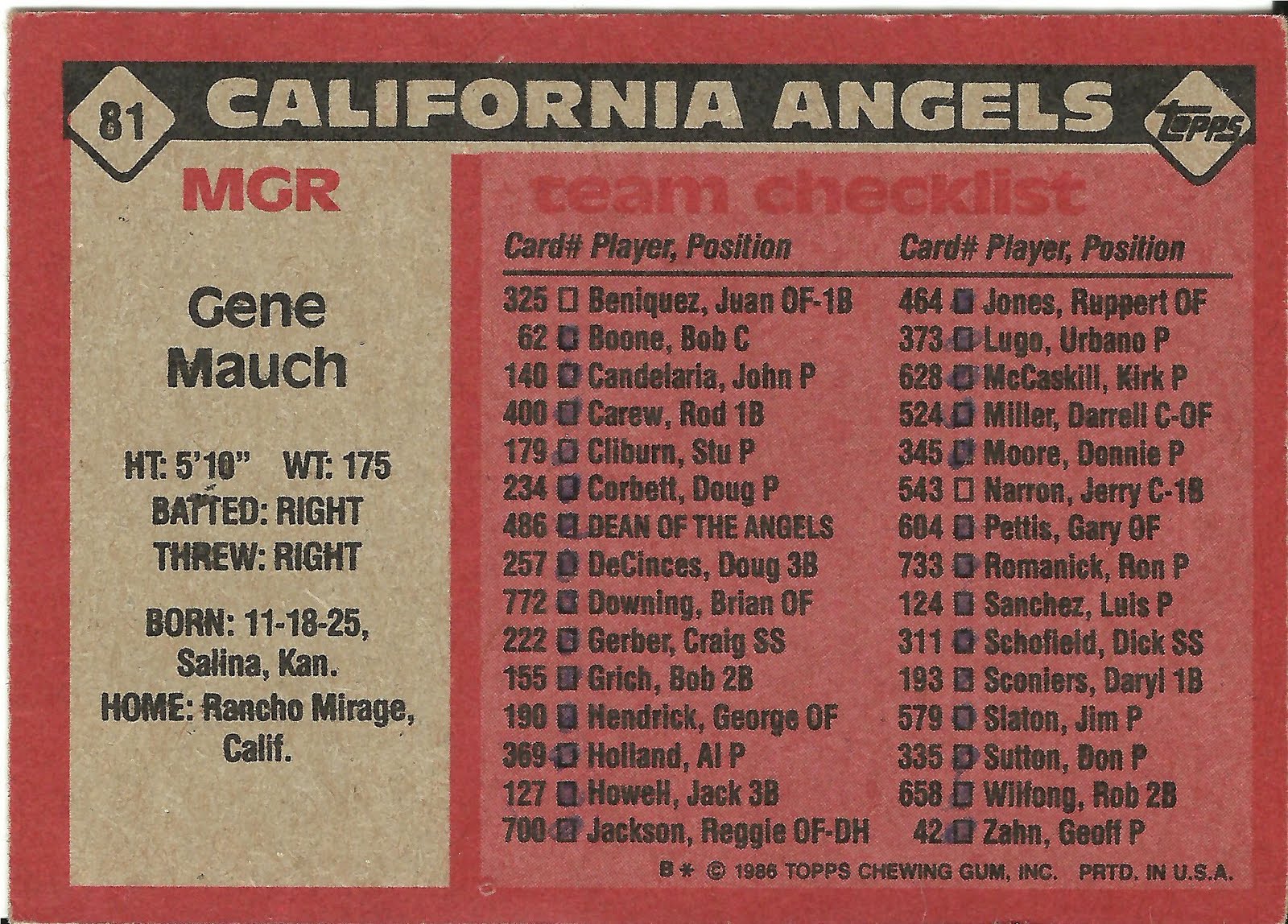
#81 Gene Mauch
Card thoughts: It may be my imagination, but I seem to recall there being a lot of crusty looking managers in 1985 who had managed for decades. They seemed recycle known quantities much more back then. This was Mauch's 25th year as manager.
The manager: Mauch was a reserve middle infielder with little power for 6 teams over 9 seasons, batting a measly .239. As a manager, in the 27 years he managed, Mauch only had two seasons when he did not manage in the majors from 1960-1987. He was a practitioner of "small ball" and loved riding the opposing players and umpires from the bench. He started by managing the Phillies for most of the 60s, garnering a .486 winning percentage. He was present for the epic collapse by the Phillies in 1964 when, up by 6 1/2 with 12 games to play, the Phillies missed winning the pennant by 2 games. The cause was his decision to ride his two aces, Jim Bunning and Chris Short too hard. Previous to this, in his second year managing the Phillies they lost 23 games in a row.
The Expos must have liked what they saw of Mauch, as he was the first manager in franchise history. Perhaps the 20 losses in a row by Expos in 1969 can be attributed to that, or perhaps Mauch was truly "ill-fated," as many believed. After 7 seasons with the Expos, none above .500, he was hired by the Twins and managed some good teams for them in the late 70s. 3 out 5 of his teams were above .500. Mauch would have his greatest success as the manager from the Angels. But he never won a pennant with them either, despite being one game away in 1982, and one strike away in 1986. The Angels were the only team he would manage to a cumulative record of over .500. He reportedly had to quit because he was chain smoking so much as a manager it was affecting his health. He eventually died of lung cancer in 2005.
Rear guard: I only needed Jerry Narron and Juan Beniquez to complete the Angels! Of course, the great omission here is Mike Witt, the top pitcher for the Angels in 1985 of whom I had no idea until I was surprised by his existence in the 1986 ALCS. I have no idea why Mike Witt's card was missing for this year, but not in 1985 or 1987. If any one knows, please comment!
Saturday, September 3, 2011
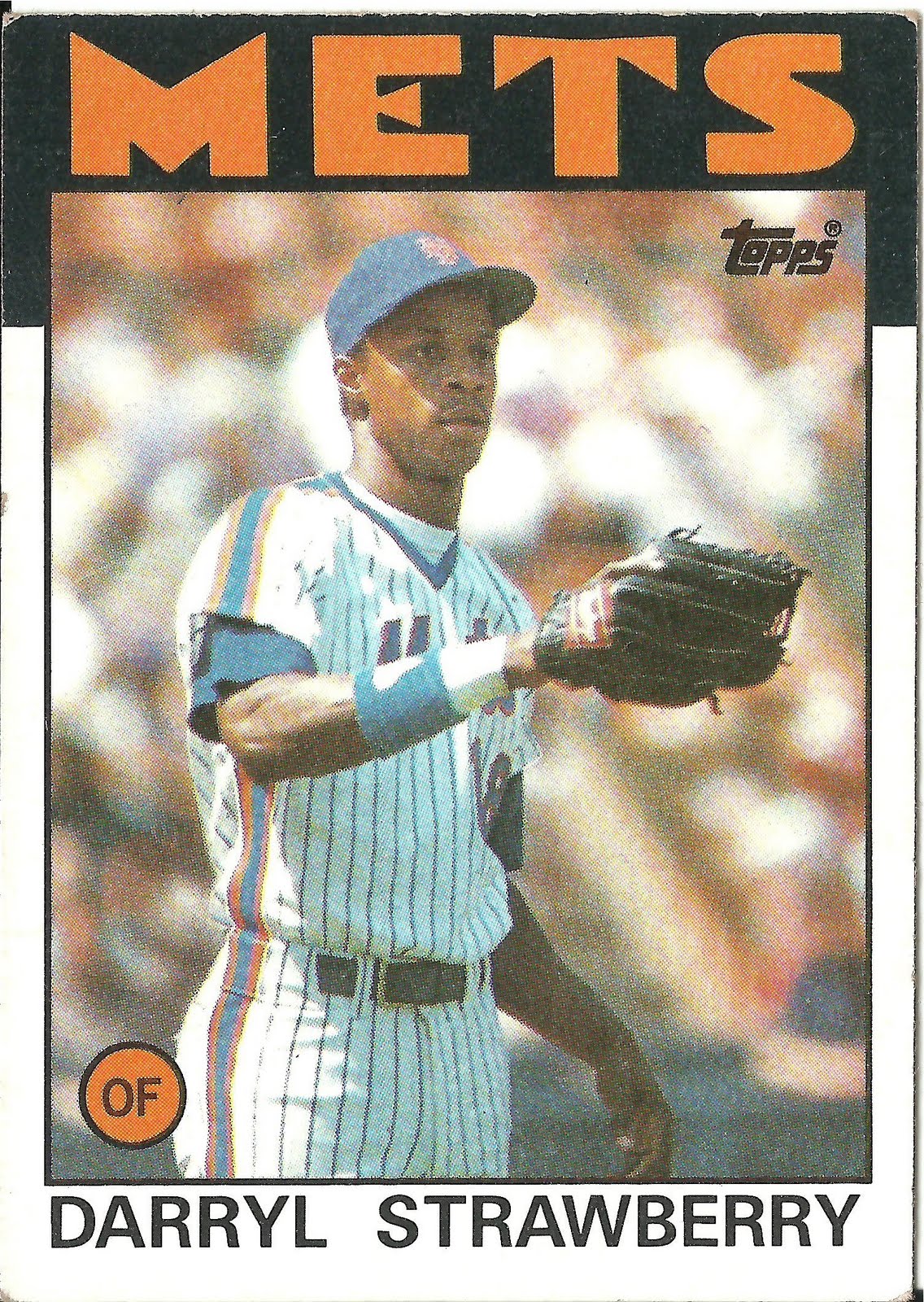
#80 Darryl Strawberry
Card thoughts: This picture was taken at Shea Stadium of Strawberry warming up before the game. But when I think of Strawberry, I have the vision of his long form rocking back, lifting his right leg, ready to lace the ball into the outfield or over the fence. And of a certain chant.
The player: Strawberry had it all. He could run, throw, hit, steal bases, hit home runs. A five-tool player. 30-30 club member. 8 straight all-star games. Rookie of the Year (1982). #1 overall pick in 1980. But it all fell apart after age 30. Like all the 80s Mets, I hated Strawberry. I'll never forget how excited I was to be able to razz Strawberry with the eternal "Da-aryl, Da-aryl" when the Cubs played the Mets at Wrigley. Bart Simpson dug this chant too (Strawberry was one of Mr. Burns' softball ringers in "Homer At The Bat"). This card shows Strawberry in his prime. He hit over 20 home runs in his first 9 seasons when that was a big deal. In 1987, 1988, and 1990 he hit over 35 home runs and drove in over a 100 as a lynchpin for the perennial Met contending teams. Many of his home runs were monster blasts (or moon shots), like this one that hit the clock at old Busch Stadium, or this one that hit the roof at Olympic Stadium. He also came up big in the post-season. He hit 4 home runs and drove in 12 in 3 post-season series with the Mets. Like most of the Mets of that era, he was also known for off-the-field incidents. He got in fights with Wally Backman and Keith Hernandez, would sleep in late and miss team workouts, and generally acted like a boor. The Mets, tiring of his disruptive behavior, did not make a big play to resign him after the 1990 season, which ended up being a smart move. Strawberry decided to sign a lucrative 5-year contract with the Dodgers, his hometown team. His first season with the team he put up his customarily great numbers, and at this point in his career he had 280 home runs, and a seemingly sure path to the Hall-of-Fame.
But as he hit age 30, his production dropped alarmingly. The fast life Strawberry was living began to catch up to him. He began to get injured regularly and he only played 75 more games over the next two seasons with the Dodgers, while also battling drug and alcohol abuse. The Dodgers released him two years early from his contract, owing him 10 million dollars. Strawberry attempted a comeback with the Giants but could only get on the field for 29 games. George Steinbenner of the Yankees then took Strawberry on in 1996 as a reclamation project, after he was suspended for cocaine (although Strawberry once said on Letterman he could never see himself playing for George). He did well as a part time player, even hitting 24 home runs in 1998. But another set back occurred when he was diagnosed with colon cancer, which spread to his lymph nodes by 2000. The cancer diagnosis sent his life into a further tailspin. He was busted for drug violations several times, and reportedly lost his will to live. However, he did live and has rehabilitated himself. Always a well-spoken fellow, Strawberry has provided analysis after the Mets games since 2007.
Rear guard: Harry Chiti happens to be the ONLY player in major league history traded for himself. Chiti hit .195 for the Mets in 15 games, so they sent him back to the Indians. He would never play another major league game.
Subscribe to:
Posts (Atom)