Monday, September 24, 2012

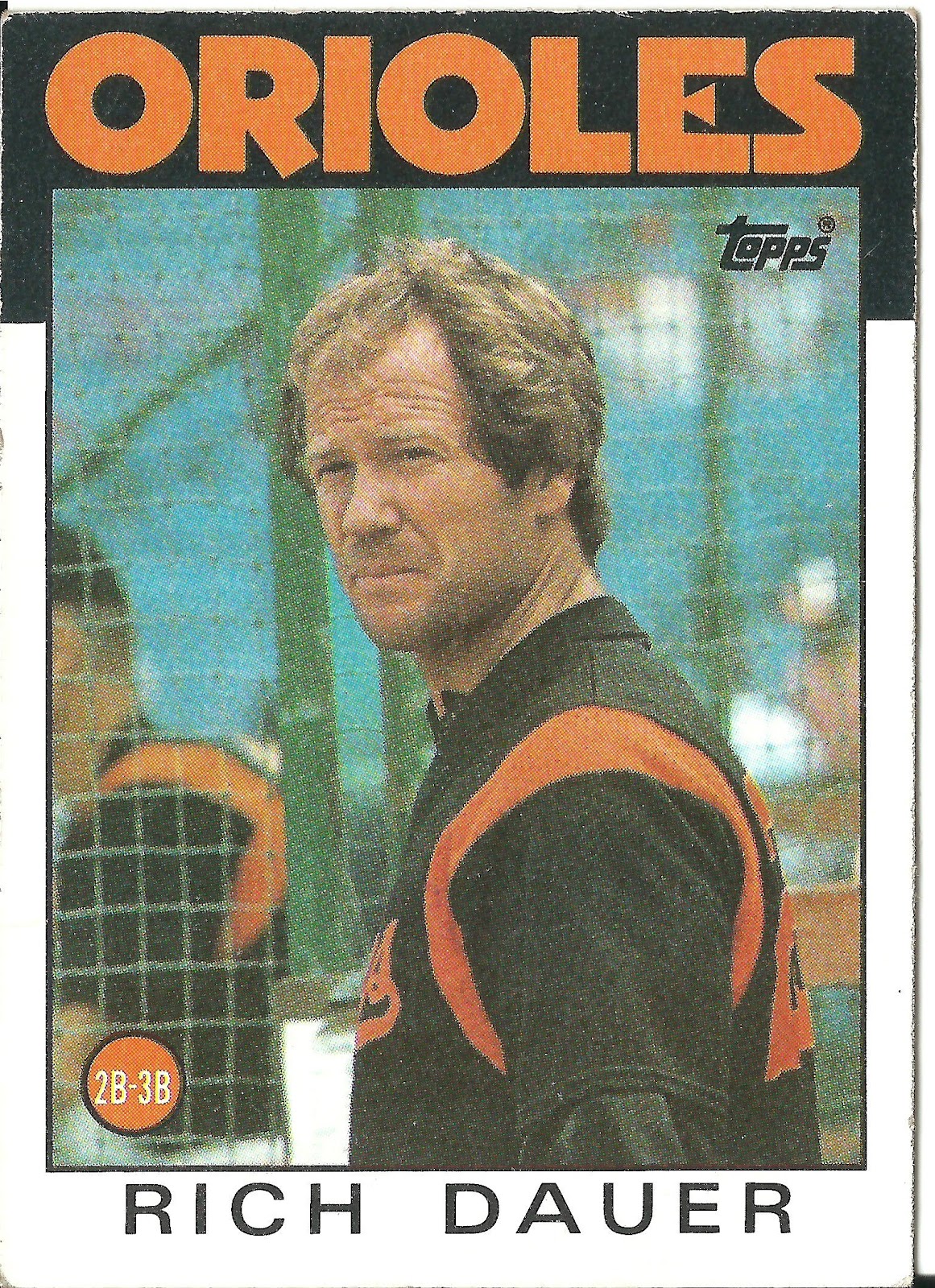
#251 Rich Dauer


Card thoughts: This would be Dauer’s last Topps card. He had spent his entire career with the Orioles. And with the hat off, Dauer looks like one of the coaches.


The player: Dauer was a good contact hitter, and a steady fielder at both second and third. In fact, at second he set an American League record with the most straight errorless games at second (long since broken). Dauer’s skill set bears an uncanny resemblance to that of the Cubs’ second baseman Darwin Barney.

Dauer was an All-American who led his college team, USC, to two straight College World Series wins. Drafted in the first round by the Orioles, he was sent directly to AA Asheville where he hit over .300.  In ’75 he was mediocre at AAA, but repeating the league in 1976, Dauer won the International League MVP award in an odd three-way tie.

Although he debuted with the Orioles that season, and he was the opening day second baseman, Dauer ceded a substantial amount of playing time to fellow youngster Billy Smith as his average of .259 was not deemed high enough for an everyday player by manager Earl Weaver. In 1978, he finally became the regular second baseman (although he also backed up Doug Decinces at third) and hit .264, striking out only 22 times. For the 1979 Pennant Winners, Dauer hit a career high 9 home runs and drove in 61. In the World Series he hit .294, and his solo home run was the only run the Orioles would score in their Game 7 loss.

As the eighties dawned, Dauer was a mainstay at second, anchoring the Orioles infield while also filling in at third and the outfield. His best season in this stretch was in 1982 when he played in a career high 158 games and also reached highs in hits (156), and runs (75),  while hitting .280. The next season, the Orioles reached the World Series and won it this time, with Dauer contributing 3 RBIs in the effort.

Dauer’s playing time declined steadily until a weak .202 average in the year represented by this card convinced him to retire. He became a third base coach with the Royals and Indians. This is the position Dauer currently holds with the Rockies.


Rear guard: Dauer's first hit came in his first major league at bat facing the Brewers. Pitcher Jim Colborn served up a single to left. Dauer later in the game drove in Bob Bailor on a groundout to second.

Monday, September 17, 2012

#250 Dwight Gooden


Card thoughts: As a batter this season, this was the most fearsome thing you could ever imagine. Dwight Gooden, about to hurl a pitch--most likely past you. Much better shot than one taken as a rookie in the dark.

The player: As a kid, I saw Gooden throw a gem against the Cubs at Wrigley. He struck out a ton of guys, and I doubt if the Cubs even scored off him. Gooden, or "Doctor K" as he was known in his prime, was one of the most exciting young pitchers ever, comparable to Bob Feller and Kerry Wood in his success at a very young age. But with that success came a price. A heavy workload as a youngster ruined his arm, and he did not handle the early fame well, ending up as a drug addict within a few years. He truly went, as the Sports Illustrated cover story said, from phenom to phantom.

But for a three year period, before he was even 21 years old, Gooden dominated like few other pitchers in history. Featuring a nasty curve and n almost unhittable fastball, he made his first start at age 19 in 1984, and he went 17-9 with a 2.60 ERA, leading the league with 276 strikeouts, and easily winning the Rookie of the Year, nearly winning the Cy Young Award, and making the all star team where he struck out the side.

It was only a taste, however, of one of the most thoroughly dominating pitching seasons in baseball history. When this card was issued, Gooden was coming off a year when he would win the pitching equivalent of the Triple Crown. His league leading 1.53 ERA was second lowest in the "live ball" era (Gibson's 1.12 in the dead ball year of 1968 holds the record), he struck out 268 batters, won 24 games (completing 16), and pitched 276 2/3 innings---leading the league in all categories. It still wasn't enough to propel the Mets into the playoffs, however.

Gooden's numbers fell off a bit in 1986, as he went 17-9 with a 2.84 ERA. He did become the youngest pitcher to start an all star game at age 21. He didn't pitch well, however, giving up 2 runs in 3 innings and getting the loss. Gooden was good in the ALCS that year, but couldn't make it out of the fifth inning in any of his World Series starts, an indication that the amount of innings on Gooden's young arm was beginning to effect his performance. Another warning sign was that he missed the Mets victory parade. This was because he was too hungover after going on an all night cocaine and alcohol bender. Gooden ended up watching the game on TV at his dealer's apartment.

Gooden's cocaine troubles came to the surface in the off-season when he was arrested for the first, of many times, DWI by the Tampa police. He still did lots of cocaine all off-season, and he was suspended in spring training when it was found in his system. Gooden managed to start 25 games and go 15-7 with a respectable 3.21 ERA. The 1988 season would be a comeback year, as he went 18-9, made the all-star team, and pitch over 200 innings.

After an injury to his shoulder in 1989 limited him to 17 starts, Gooden would have one last dominant season, going 19-7 and 223 strikeouts, second n the league. Another injury in 1991 finished out the dominant period of Gooden's career. Although he went 13-7, he no longer could strikeout almost a batter an inning, and his walks and ERA climbed. a 10-13 and 12-15 record got the Mets in the subsequent two seasons led many to conclude that Gooden was done. And his behavior became more erratic. Testing positive twice for cocaine in 1994, he only made 7 starts that year, and was suspended the following season after again testing postive during his first suspension. During this time, Gooden attempted suicide.

Gooden was not resigned by the Mets, and George Steinbrenner who, whatever his faults, was always willing to give "damaged goods" another changed, signed him to pitch for the Yankees in 1996. He managed to go 11-7, and even no-hit the Mariners on May 14. But he had to be shut down at the end of the season because of arm fatigue, and his ERA was an awful 5.01.

Another mediocre season with the Yankees followed, and Gooden started for the Indians in 1998 and 1999, and pitched for the Astros, Devil Rays, and Yankees in 2000. He ended his career, mopping up in two playoff games for the Yankees.

Despite all of the troubles, Gooden ended up pitching 16 seasons. He won over 100 games by the age of 25, and only 75 after, finishing with a career record of 194-112. What could have been.

As you can probably guess, Gooden's alcohol and drug problems became even worse after his retirement, without the structure of baseball to rein him in. He even chose to go to jail for a time to kick his habits, but to no avail. If you are one of those sick people who enjoy watching the suffering of others, you can catch Gooden on the 2011 season of Celebrity Rehab.


Rear guard: Look at that. His first shutout was only a month after his first win. Gooden pitched a 4-hitter, striking out 11 in a duel against the Dodger great Fernando Valenzuela.

Ooh! 2 sacrifice flies in one game! Now I know for most of the Mets history they were seen as a kind of a loser franchise, but they did win in '69. Give em a break with the pathetic stats! Jesse Gonder (shown here on his 1964 card), was a backup catcher the Mets acquired in July for Charlie Neal and Sammy Taylor (sent to the Reds). He had only 6 sacrifice flies in his career, and his 2 in that August game were his only 2 of the year. They drove in Duke Snider with the Mets' fourth run, and Ron Hunt with the sixth.

This date in baseball history: Well, whaddya know. Our featured attraction, Dwight Gooden, strikes out 16 Phillies in 1984 to set a two game strikeout record.
Wednesday, September 12, 2012

#249 Rob Deer


Card thoughts: I forgot that Deer played for the Giants. I remember him mainly as a Brewer or Tiger. This picture is taken before a game at Candlestick Park . . . which looks chilly as always. This is Deer's first base Topps card, and only one as a Giant.

The player: While Deer was not a particularly good player, he is an important harbinger of the type of player much more common today. This type of player is attempt at achieving on of the so-called Three True Outcomes. You see, when Deer came the plate, he either hit a home run, struck out, or walked. Of his 853 career hits, over a quarter were home runs. He struck out over 30% of the time in his career as well. Mark Reynolds, Adam Dunn, and a myriad of other high strikeout/low average power hitters now in the league: Meet your God.

Deer was already whiffing at a league leading rate in the minors, leading the California, Texas (twice), and Pacific Coast League in strikeouts for 4 years before making his debut with the Giants in 1984. Of course, he also led in home runs in 3 of those years.

He hit only 8 home runs in his first full season with 71 strikeouts and a .185 average. The Giants, feeling he would never hit with enough power at home to make up for his poor average, shipped him to the Brewers for two players who never made the majors. It turned out to be a steal for the Brewers, as Deer was the spark plug for a very successful 1987 team that won a record 12 in a row to start the season. He even made the cover of Sports Illustrated after hitting the home run that won the 12th game. For the rest of the season, Deer hit .232 with 33 homers and his usual astronomically high strikeout totals, this time not leading the league. But Deer was not just a one dimensional player, as he patrolled right field with great verve.

After four more seasons with the Brewers, where he never again hit more than 30 homers [and led the league in strikeouts in 1987 (186--then a record) and 1988 (153)], Deer signed with the Tigers. Tiger Stadium, with its short upper deck porch, was very inviting for someone with Deer's power, but he may have been too eager in 1991, his first season with the club. He hit .179, the lowest ever average for someone with enough at bats for the batting title.  Deer bounced back the next year, hitting 32 home runs (with only 64 RBIs!), and respectable .247 average. But a .217 average in 1993 was enough for the Tigers to sell him to the Red Sox. Between the two teams, he hit .210 with 21 home runs, 54 RBIs, and a league leading 169 strikeouts.

Deer went to Japan for a year, and then attempted a comeback with the Padres where he hit only .180 in 50 at bats, but with an incredible .480 slugging percentage.

Deer is now a roving batting instructor with his first team, the Giants and owns the oddly named Viz-U-Bat company, which does something I don't quite understand.


Rear guard: Deer's first homer came off Braves pitcher Rick Camp. His line that day can be a summary of his entire career: in his 3 at bats, 1 homer, 1 walk, 1 strikeout.

This date in baseball history: Huh. Before 1931 in the National League, a ball that bounced over the fence was considered a home run. Al Lopez of the Dodgers hit the last of these "bounce" homeruns in Ebbets Field in 1930.