Thursday, September 29, 2011

#92 Al Cowens


Card thoughts: This card always upset me as a kid. I could never figure out what Cowens was doing. This is more of a shot for a football card.

The player: Al Cowens had a fairly ordinary career. He had just enough speed and hitting ability to be an everyday player for the Royals, Angels, Tigers, and Mariners, but played without much distinction save one awesome season. In 1977, Cowens played in every game and hit 23 home runs, drove in 112 runs, and hit .312 with a .525 slugging percentage, coming in second to Rod Carew in the MVP voting despite not making the all-star team. He even won a gold glove. Cowens never matched that production in any other season. He didn't even reach double digits again in home runs until he was traded to the Mariners in 1982. In between, Cowens had a two year stint with the Tigers which was memorable, but not for Cowens baseball hitting ability. While with the Tigers, Cowens attacked White Sox pitcher Ed Farmer in retalliation for being hit by a pitch the previous season when he was still with the Royals. A warrant for assault was issued for his arrest in Illinois and Cowens had to leave town for the rest of the series. Farmer dropped the charge on condition that Cowens shake his hand. He was known as "Coward Cowens" at Comiskey for the rest of his career.

Cowens finally found his power again in his last years as a player with the Mariners, hitting 20, 15, and 14 home runs with the team between 1982 and 1985. He was released by the team on June 12, 1986 after playing 20 games. He died of a heart attack in 2002 at age 50.


Rear guard: That extraordinary 1977 season really stands out when you line it up with all the other ones, especially the power numbers.

Wednesday, September 28, 2011

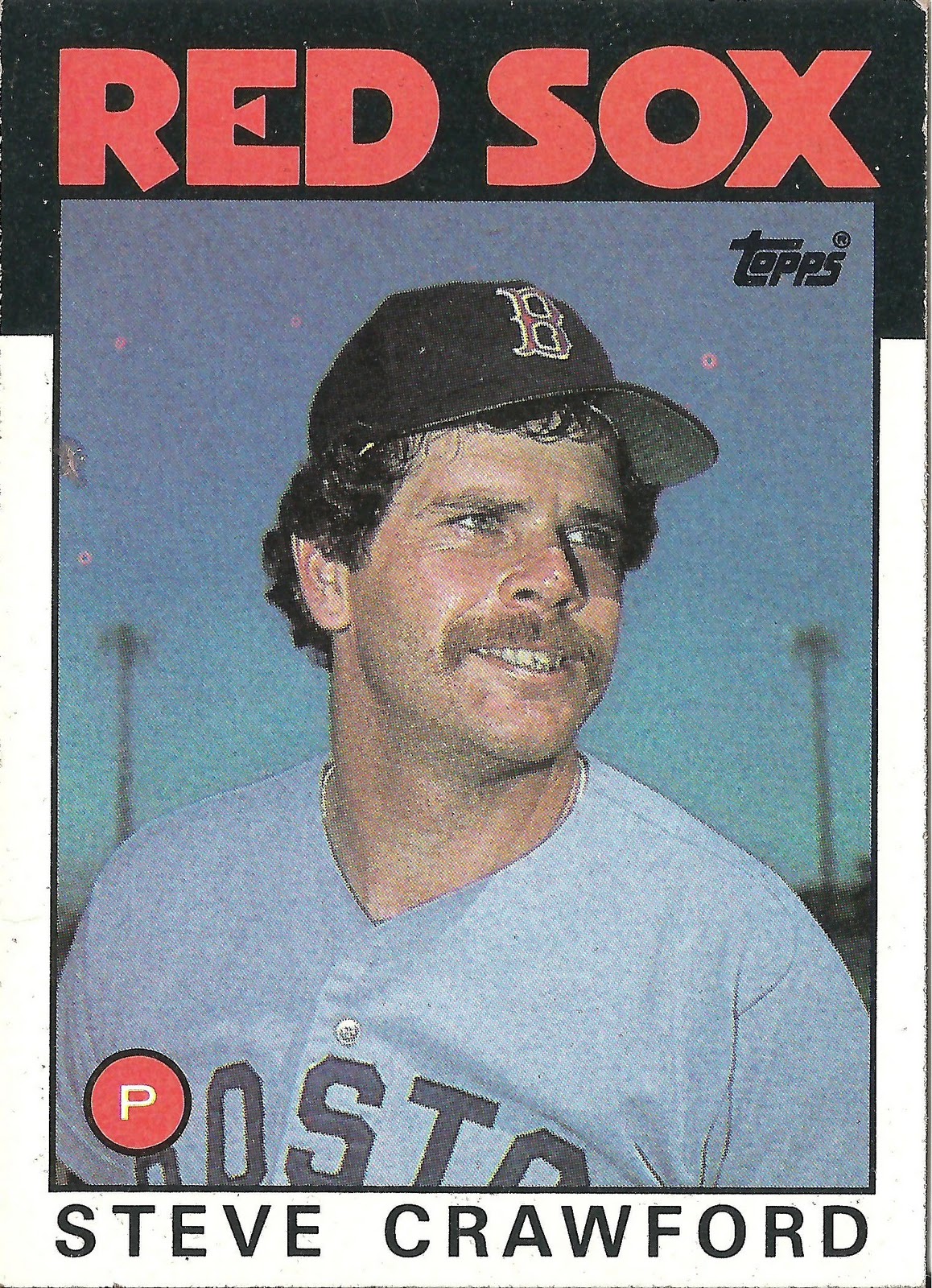
#91 Steve Crawford


Card thoughts: Another baseball season over. Even though the team I follow tanked (as usual), I'll still be sad all winter long as the wind howls around the house and snow and sleet eddy up onto the porch. Hopefully, this blog will keep me (and anyone who may be reading this) dreaming of a warm summer day at the ballpark. Of course, with these players, I might start dreaming of long ago summer days of playing pickup basketball (and baseball) and riding up to Revco or going to Gary's Dugout to pick up some more cards. Well enough of this Proustian nonsense (I guess I am reading Within a Budding Grove). On to the set!

This card has the same lighting as #11 Bob Ojeda and was no doubt taken on the same day in Florida (note the dual palm trees perfectly framing Crawford). This is the first of the "sweaty" Red Sox cards. A very famous Red Sox later in the set looks even greasier than this guy.

The player: Crawford came up in 1980 and pitched sporadically out of the bullpen (and as a starter in an ill-fated 1981 campaign), before 1985. In the days before every team had an everyday closer, Crawford shared that role with Bob Stanley during the season shown on this card. It would be his best year. He had 12 saves to go along with a career high 91 innings pitched. He would win 2 games in relief during the post-season for the pennant-winning 1986 Red Sox, but would only pitch one more season with the Sox before he signed with the Dodgers, who he never pitched in the majors for. The next year, he signed with the Royals and pitched 3 more seasons with them as a middle reliever, retiring in 1991.


Rear guard: Crawford's first win shows how much the game has changed. It was a complete game victory over the Rangers where he gave up 12 hits, 3 runs, and 2 walks. They didn't have pitch counts back then, but I'm guessing he threw more than 120 pitches.

Tony Conigliaro's career hit a setback the year he reached 100 home runs. He was hit in the eye by a pitch on August 18 and missed the rest of the season and all of the next. Although he had his best season a year after he returned, hitting 36 home runs and driving in 116 runs in 1970, he essentially retired by the age of 26 due to persistent vision problems.

Monday, September 26, 2011

#90 Garry Templeton

Card thoughts: Garry with two Rs? Okay, whatever. This card lacks the finish of the other cards in this set. The front is lightly rough to the touch.

The player: Nicknamed "Jumpsteady," Templeton stormed into the National League at the young age of 20 and his early career eerily resembles that of Cubs shortstop phenom Starlin Castro. He had speed (although he was caught stealing a lot), great range and arm (although he committed lots of errors), and could hit for average. He led the league in triples from 1977-1979, and in hits in 1979. Despite his great season in 1979, Templeton was not voted in as a starter for the all-star game. He petulantly refused to go to the game when selected as a reserve, although the quote "If I'm not startin', I'm not departin'" commonly attributed to him was actually said by broadcaster Jack Buck. Templeton started doing heavy drugs in the early 80s which led to some erratic behavior. He told manager Whitey Herzog that he would no longer play day games after night games. In 1981, after being booed for failing to run out a dropped third strike, Templeton made several obscene gestures to the fans and got in a fight with Herzog. 

The Cardinals needed to get rid of the unpopular and unhappy player and engineered a trade with the Padres for future hall-of-famer Ozzie Smith. This was not the lopsided trade it seems today. Smith and Templeton were about equal defensively, but Smith couldn't hit a lick at that time. But Smith learned how to hit with the Cardinals and Templeton's knees started to go while with the Padres and he never regained his early career form as a hitter. However, he did mature and was considered the team leader on the 1984 pennant winning Padres (and is one of their all-time most popular players). The year shown on this card was Templeton's last all-star appearance and his career began to slowly decline soon after. He ended his career in 1991 with the Mets and managed to get 2,000 hits. Here's an excellent fan site for Templeton.


Rear guard: Templeton's homers came from the lead off spot off of the Braves' starter Mickey Mahler and losing pitcher Craig Skok. His second homer was the deciding run in the Cardinals 5-4 win.