Monday, October 7, 2013

#364 Reid Nichols


Card thoughts: Reid was a very unusual name in 1986. Of course, now tons of kids have it.

The player: Nichols was viewed as an up and comer by the Red Sox as a rookie. He hit .302 in a platoon role with Rick Miller, and showed flashes of power and speed. His OPS was again above average in 1983, when he hit .285. This led to a pretty big long-term contract (unusual for a reserve).  But with the signing of #255 TonyArmas, Nichols was received much less playing time. In a large part a defensive replacement in 1984, he hit just .226. When he started the season shown on this card with a .188 average, he was traded to the White Sox for #297 Tim Lollar.

The White Sox did not have the same dominant outfield as the Red Sox, so Nichols got more at bats after the traded. He swatted .297, and his OPS was on par with his better seasons as a Red Sock. However, he struggled again in 1986, leading to his release.  Nichols would finish his career as a reserve outfielder for the Expos.

Despite a career where he was a barely above replacement level outfielder, Nichols had enough baseball acumen that he has been the farm director for the Texas Rangers (1994-2000) and the Milwaukee Brewers since 2002. He’s been responsible for developing players like Ryan Braun, Corey Hart, Prince Fielder, Rickey Weeks, and Yovani Gallardo. Of course, he’s also been responsible for flameouts such as Mat Gamel.


Rear guard: Wow. Unaware two Ed Walsh's pitched for the White Sox! The elder Walsh (Big Ed), has an awesome profile picture, and routinely pitched over 300 innings. One of the greatest pitchers ever, he's second all time with an incredible 1.00 WHIP, and his career ERA is a microscopic 1.82. Hard to believe it took the old timers committee to vote him in to the Hall of Fame.

Like many pitchers of his day, the elder Walsh blew his arm out by age 31 after winning 182 games. His son, on the other hand, was a really bad pitcher, with a career ERA above 5. He won just 11 career games


Thursday, October 3, 2013

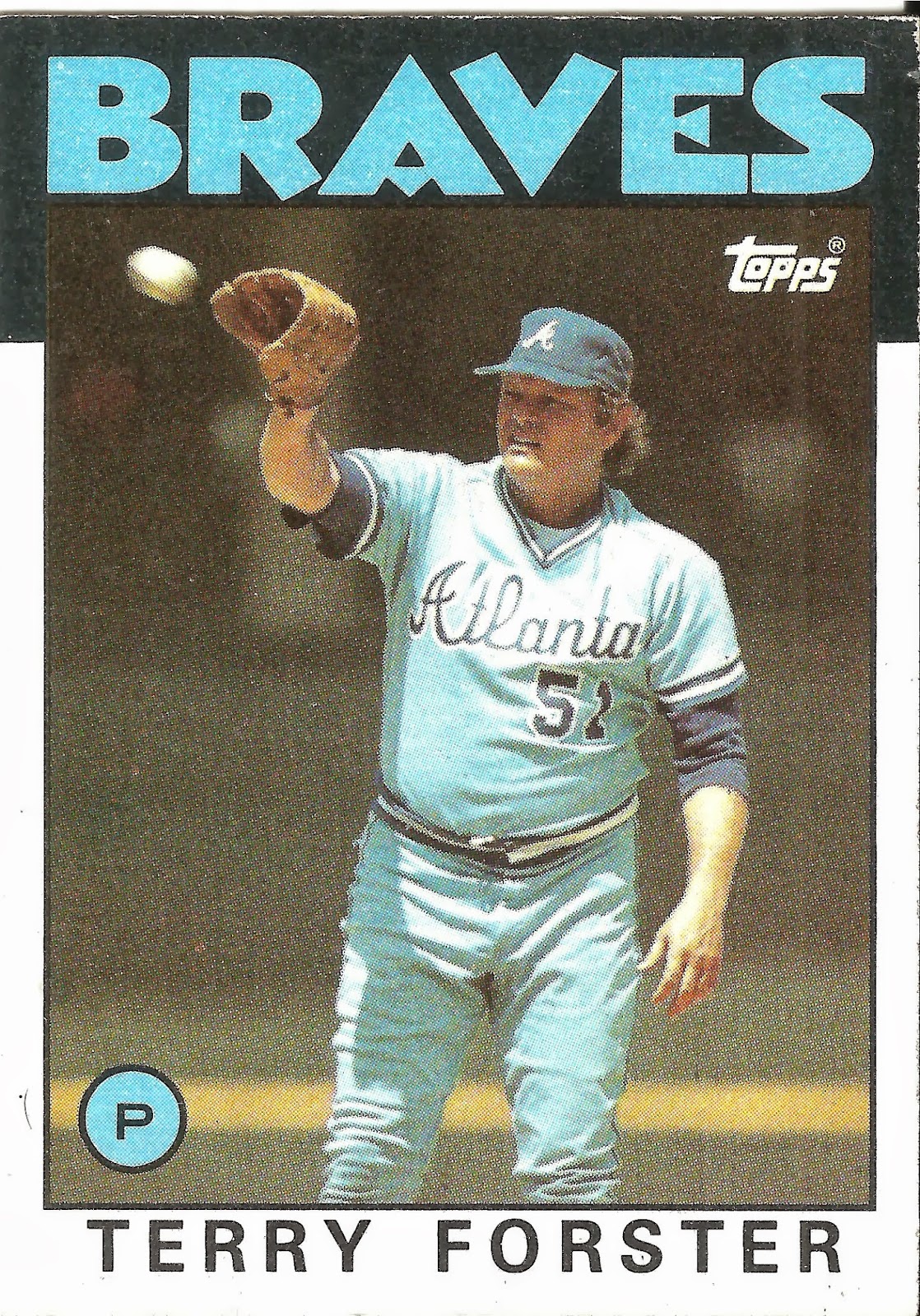
#363 Terry Forster


Card thoughts: Forster, who was once called a “Fat Tub of Goo” by David Letterman, is certainly showing the weight in this picture.

The player: Before being the most celebrated fat man in baseball, Forster was a star closer (or “Fireman,” in the parlance of today) for the White Sox. Unfortunately, both his weight, and wicked slider, led to a myriad of injuries.

Forster came directly into the league from A-ball, but at age 20, he saved 29 games.  They tried starting him in 1973, but he was back in the pen in 1974, with a league leading 24 saves. Arm trouble in 1975 led to an almost year long haitus. Further adding to his agonies, his brother was killed in a bar brawl in the off season, with Forster present.

When Forster returned in 1976, he found that Rich Gossage had supplanted him as the ace in the White Sox bullpen. The White Sox decided to put him back in the rotation, where his 2-12 record led to him being included with Rich Gossage in a trade to the Pirates. He was happy with the trade, partly because he was reunited with former manager #351 Chuck Tanner, and also because Forster was a good hitter and liked to swing the bat. He hit .346 his first season with the Pirates, but he was still battling arm fatigue, and was not much of a factor in his only season with the team.

A trade to the Dodgers improved his stock dramatically. Always a better pitcher in a spacious, grass park, Forster saved 22 games with a 1.93 ERA in 1978. Unfortunately, two more years of ill-health limited his effectiveness until 1982, when he pitched 83 innings and saved 3 games with an ERA just above 3.

The now portly Forster signed a big contract with the Braves in the off season, and his first season with them was a good one, as he saved 13 games with a 2.13 ERA. But Forster gained national notoriety when David Letterman called him a “fat tub of goo” in his opening monologue. Instead of getting angry, he went on Letterman and managed to one-up Dave on occasion and be very funny in his own right. Forster later sang the novelty song “Fat is In,” which I can’t find anywhere online, which is lucky for you.

Despite all the self-deprecation, Forster was concerned about his weight and slimmed down a bit after declaring free agency. He actually was worse in 1986 after the weight loss, as his ERA “ballooned” to 3.51 with the Angels (his new team). But he didn’t get injured, at least (although he did not appear in the post-season).

Still overweight, there was no uniform big enough for Terry when he signed with the Twins AAA team in 1987. One had to be specially shipped in from Milwaukee to cover his 260 pound frame.

A rarity among relievers, Forster hit an incredible .397 in his career, which, believe it or not, is the highest career batting average for a player with over 50 career at bats. In a typical self-deprecating comment, he insisted many of the hits broke his bats, and were the result of good luck.


Rear guard: 210 pounds? I don't think so (which goes to show the vitals are always from the players rookie year. Don't believe them!) 


Monday, September 23, 2013

#362 Tom Paciorek


Card thoughts: Second high-five picture in the set! And since Paciorek only hit one home run in a Mets uniform, we should be able to identify the circumstance, and his mysterious high-fiving partner. This picture was taken on August 15, in the first inning. Paciorek was the second batter of the game, and he drove in leadoff man, #191 Wally Backman, who had earlier taken a walk. As a child, I pronounced his name “Passiorek.”

The player: Paciorek, who was nicknamed “Wimpy” for some unknown reason, was the most successful of three baseball playing brothers.  One of the myriad of great hitting prospects the Dodgers had in the early 70s, like of many of those players he tore up the PCL, driving in over 100 runs three straight seasons (1970-1972).  Despite this, he was unable to make it to the majors for more than a cup of coffee until 1973. When he did, he was blocked at first by former Spokane teammate Steve Garvey, and in the outfield by a trio of solid veterans (Manny Mota, Willie Davis, and Willie Crawford). Paciorek never would get a chance to be more than a fourth outfielder in LA, as in the next two seasons youngster Bill Buckner and import Jim Wynn would take up the majority of the outfield playing time in left and center, respectively.

Suffering from lack of playing time, Wimpy’s average dipped to .190 in 1976, prompting a trade to the Braves. He still was in a reserve role, but the Braves starting outfielders were far inferior to the Dodgers, so his playing time increased accordingly. Playing in 110 games, Paciorek hit .290 with a league average OPS. He slumped in 1977, and was bad in spring training the next year, prompting the Braves to put him on waivers. He cleared, and went to Richmond for a week. However, he was added to the 40-man again when Gary Mathews separated his shoulder. After only 5 games, he was once again put on waivers, but this time the Mariners claimed him when he failed to report to the minors. Paciorek finished the year strong, hitting .299 for the Mariners.

Paciorek finally got a chance to be a full-time player in 1981, and he made the most of it. Unfortunately, the season was strike shortened so we’ll never know what Paciorek could have done in a full season. He did make his first all star team, and even was tenth in the MVP voting. Top 10 rankings in hits (fifth), total bases (third), OPS (fourth), batting average (second), slugging (fourth), runs batted in (sixth), and doubles (third) made his case, although it is doubtful that those numbers would have held up over a full season.

Then the Mariners foolishly traded him to the White Sox for three nobodies (Jim Essian, Todd Cruz, and Rod Allen). Paciorek would hit over .300 his first two years with the White Sox, and would be their starting first baseman in 1983, the year they went to the ALCS (he hit .250 in the series). The next year, he would set a record by getting 5 hits in a 25-inning game, the most for a player who didn’t start the game (he entered in the fourth inning).

With the Mets breathing down the Cardinals neck in 1985, the coveted some veteran help off the bench to complement their young squad. Paciorek joined the team in July, and hit .284 down the stretch. He would not be able to enjoy the Mets success in 1986, however, as he was playing with the Rangers by then for his final full season.

Paciorek has remained well known in Chicago, particularly for his color commentary on White Sox games from 1988-1999 with the unlistenable Hawk Harrelson (I found “Wimpy” to be the only tolerable thing about watching the Sox). He subsequently did color for the Tigers, Mariners, Braves, and Nationals. His name was once again in the news a few years ago when he accused Rev. Gerald Shirilla of molesting him and his brothers when he was teaching at St. Ladislaus High school.


Rear guard: If you squint hard enough (or just click on the above image) you'll note that Paciorek played in exactly the same number of games with the White Sox and Mets in 1985, and had near identical offensive numbers.