Wednesday, December 14, 2011
#131 Razor Shines
Card thoughts: I was so excited to get this card. Why? Because this player has the baddest name ever. And he's glowing in the picture! The first of the glowing Expos. This is Shines only regular season Topps card. And he didn't play one game at third in the majors that year.
The player: Despite the awesome name, Shines career was anything but. Drafted in 1978, his career stalled out in AAA in 1983. As a catcher, he was blocked by Gary Carter, so he learned to play first. After brief tastes of the majors in 1983 (3 games) and 1984 (12 games), Shines was handed the opening day first base starter role in the season shown on this card. But Shines hit only .120 in 54 at bats, causing the Expos to look to another youngster to fill the role, the "Big Cat" Andres Galarraga. Although he hit poorly as well, he had a lot more promise than Shines. He went back down the Indianapolis Indians where he played for the next 7 seasons, (with a brief exile to Buffalo in 1990), becoming a local cult hero. They even had a "Razor Shines Day" when he was back in town as the manager of the White Sox AAA club.
After his playing days were over, like the baseball lifer he is, Shines began managing and coaching in the minors. He coached in majors with both the White Sox (2007) and the Mets (2009-2010).
Rear guard: Shines major league career had so little promise, Topps didn't bother with the career firsts on this one. You can see at this point that Shines has a penchant for repeating levels in the minors (already 5 seasons at AAA), not a good sign for a prospect.
Tuesday, December 13, 2011
#130 Alan Trammell
Card thoughts: Apparently #121 Nelson Simmons wasn't so alone. Looks like Trammell was right there with him (and looks similarly miserable).
The player: For the first six years of Trammell's 20 year career, he was one of the better American League shortstops in the field. He had above average range, a strong, accurate arm, and didn't make a lot of sloppy errors. Starting about 1983, Trammell began hitting the ball with more authority: He began to reach double digits in home runs and hit over .300 consistently. His first great season was the Tigers' World Series winning year of 1984. He finished in the top 10 in MVP voting while hitting .314 and driving in 69 runs. He also won his fourth gold glove and went to his second all-star game. Trammell also batted .364 in the ALCS and .450 in the World Series.His best year came in 1987 however when he hit .343 garnered over 200 hits and drove in and scored over 100 runs. All these were career highs. He came in second in the MVP voting. Trammell would remain a productive player for the next several years, but injuries began eating significantly into his playing time after 1990.
Trammell retired in 1996, after playing his entire 20 year career with the Tigers, including a record 19 with #20 Lou Whitaker as his double play partner. There are many who believe that Trammell should be in the hall of fame (he got 24% of the votes he needed in the latest election). When you compare his stats to hall of famers Rabbit Maranville, Luke Appling, and Marty Marion, he certainly tops these guys. But he is unfairly compared to the modern day slugging shortstops rather than his peers who, with the exception of Ozzie Smith (for fielding) and Cal Ripken (for hitting) few could touch. That being said, his statistics compare to Edgar Renteria (not hall of fame caliber) and Barry Larkin (debatable). A longer discussion of whether Trammell is hall-worthy can be found here.
After his retirement, Trammell coached, and then managed, some horrendous Tiger team. The team he helmed in 2003 is the worst AL team ever in terms of losses (119). The next two years weren't much better, as the Tigers lost 90 or more each year. After being fired by the Tigers in 2005, he eventually became the bench coach for the Cubs from 2007-2010. After being passed over for the manager job in 2011, he rejoined his old teammate and batting and hitting coach Kirk Gibson as the bench coach for the Diamondbacks.
Rear guard: I turned 7 the day Trammell hit his first home run of the 1982 season against the Twins' Brad Havens. That grand slam drove in Lance Parrish, Johnny Wockenfuss, and Lynn Jones and cut the Twins' lead, 5-0 at the time, to just one run.
Monday, December 12, 2011
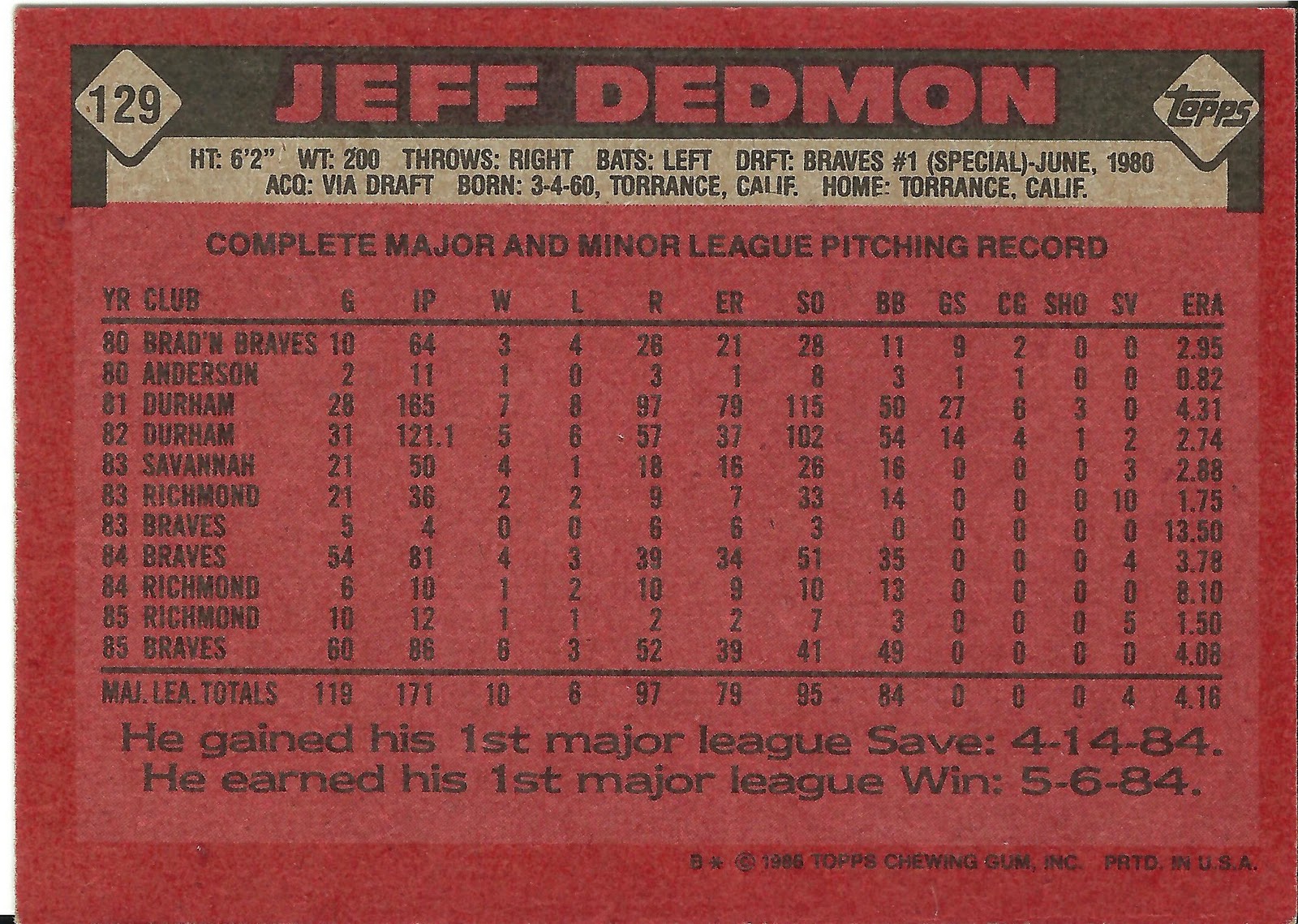
#129 Jeff Dedmon
Card thoughts: Blue, blue everywhere. Shot in one of those cavernous, identical NL East stadia.
The player: The hardest player to write about is the middle reliever. Their careers are generally short, and there aren't many distinguishing features. Highly sought after as an amateur (he was drafted in the first round by three different teams), Dedmon played 6 years in the majors, all but one for the Braves. He threw hard, and also featured a knuckle curve. However, Dedmon tended to be wild, which limited his effectiveness. His best season was in 1986 when he went 6-6, pitched a career high 99 2/3 innings, and had a 2.98 ERA. After being traded to the Indians in 1987, Dedmon retired the next season.
Rear guard: Dedmon really earned that first save, logging 3 2/3 innings of shutout baseball in relief of Rick Camp. He walked one and struck out one Padre.
Subscribe to:
Posts (Atom)