Tuesday, September 13, 2011

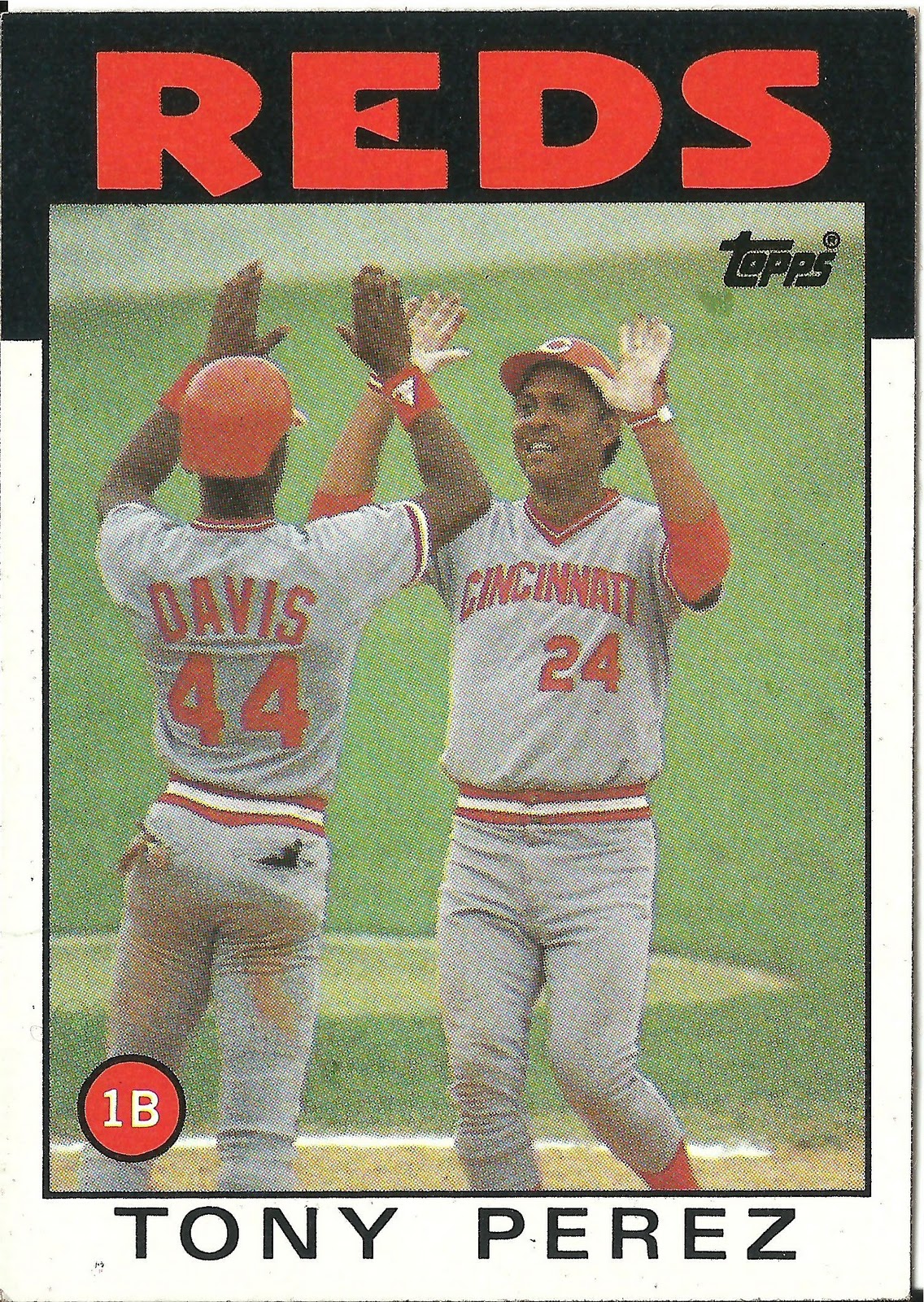
#85 Tony Perez


Card thoughts: One my favorite cards in the set. It's not often you see a player card where another player is as prominent. In this case, it is up and coming star #28 Eric Davis whose own card in this set is not as interesting. This photographer must have dug the symbolism of Perez, Reds legend, near the end of 23-year career passing the torch to the next generation.

The player: Perez was one of the greatest players in the 70s, on one of the greatest teams of the 70s: The Cincinnati Reds. From 1967-1977, Perez drove in over 90 runs every year, and over 100 runs 6 times--although curiously for a man known as one of the best RBI guys of his era, he never led the league. He was a 7-time all star as well. Starting out as a third baseman, Perez' poor fielding moved him to first in 1972. He was a fairly poor fielder at first as well, but he was in the lineup for his bat, not his glove. His best season on the Big Red Machine came in 1970 when he hit a career high with 40 home runs, runs batted in with 129, runs with 107, and batting average with a .317 mark. When the Reds went to World Series (and they went often in Perez' time with the team: 1970, 1972, 1975, and 1976), he was productive, driving in 11 runs in 24 games.

Despite his continued success with the Reds, he was traded after the 1976 season to the Expos for mediocre starter Woody Fryman and durable reliever Dale Murray. This was the start of the break-up of the Big Red Machine. His first year in Montreal was as productive as the old days, but the last two years Perez began to show his age as he neared his late 30s. He experienced a renaissance year in 1980 with the Red Sox when he drove in over 100 for the last time. But he would never again be a regular player for the rest of his career. Reuniting with former Reds teammates Joe Morgan and Pete Rose, he came off the bench for the Phillies in 1983 World Series but only hit .200. Rose brought him back to the Reds when he became manager in 1984, and he had some good years, even managing to hit .325 as pinch hitter during year represented by this card. He retired in 1986, 28th all-time in runs batted in.

Perez was fired 44 games into his managerial career by the Reds. He took the Marlins over for their last 114 games of the 2001 season and finished 4th. He was elected to the Hall of Fame in 2000, despite having comparable numbers to Harold Baines, Dave Parker, and Rusty Stab, none of whom are considered hall-of-famers. However, Andre Dawson, Al Kaline, Jim Rice, and Billy Williams, who are also comparable, are in. No doubt, Perez' "intangibles" (he was a franchise type player on a deservedly famous, successful team) helped him get in.


Rear guard: Always fascinated as a kid by the players who had played so long, you could barely read their stats. All those years, and no league leaders.

Monday, September 12, 2011

#84 Curt Young


Card thoughts: Seeing this combination of A's colors always brings me back to seeing the old Madison Muskies, Oakland's A ball affiliate in the Midwest League. Other than that, Young looks like the grown-up singer of one of those 70s "family" bands.

The player: Young was one of the unheralded pitchers for the A's dynasty from 1988-1990. Overshadowed by such star starters as Dave Stewart and Bob Welch, Young won 13 games in both 1986 and 1987, although doubtless he was helped by the A's potent offense. He also pitched a one-hitter in each of those seasons against the Royals and White Sox. When the A's started their run of 3 straight pennants in 1988, Young contributed 11 wins. Although he was not in the A's post-season rotation, he pitched in 2 games without giving up an earned run. In 1989 when the A's won the World Series, he was left off the post-season roster due to his poor 5-9 record. He bounced back with a 9-6 mark the following year (and gave up no runs in one World Series appearance), but that would be his last as regular starter. He pitched mostly in relief his last 3 seasons, splitting time with the Yankees, Royals, and a last fling with the A's in 1993.

Young was the A's pitching coach from 2004 to 2010. He currently fills that capacity with the Boston Red Sox.


Rear guard: Young gave up only 2 hits and no runs in first win, beating the Royals #77 Charlie Liebrandt.

Sunday, September 11, 2011

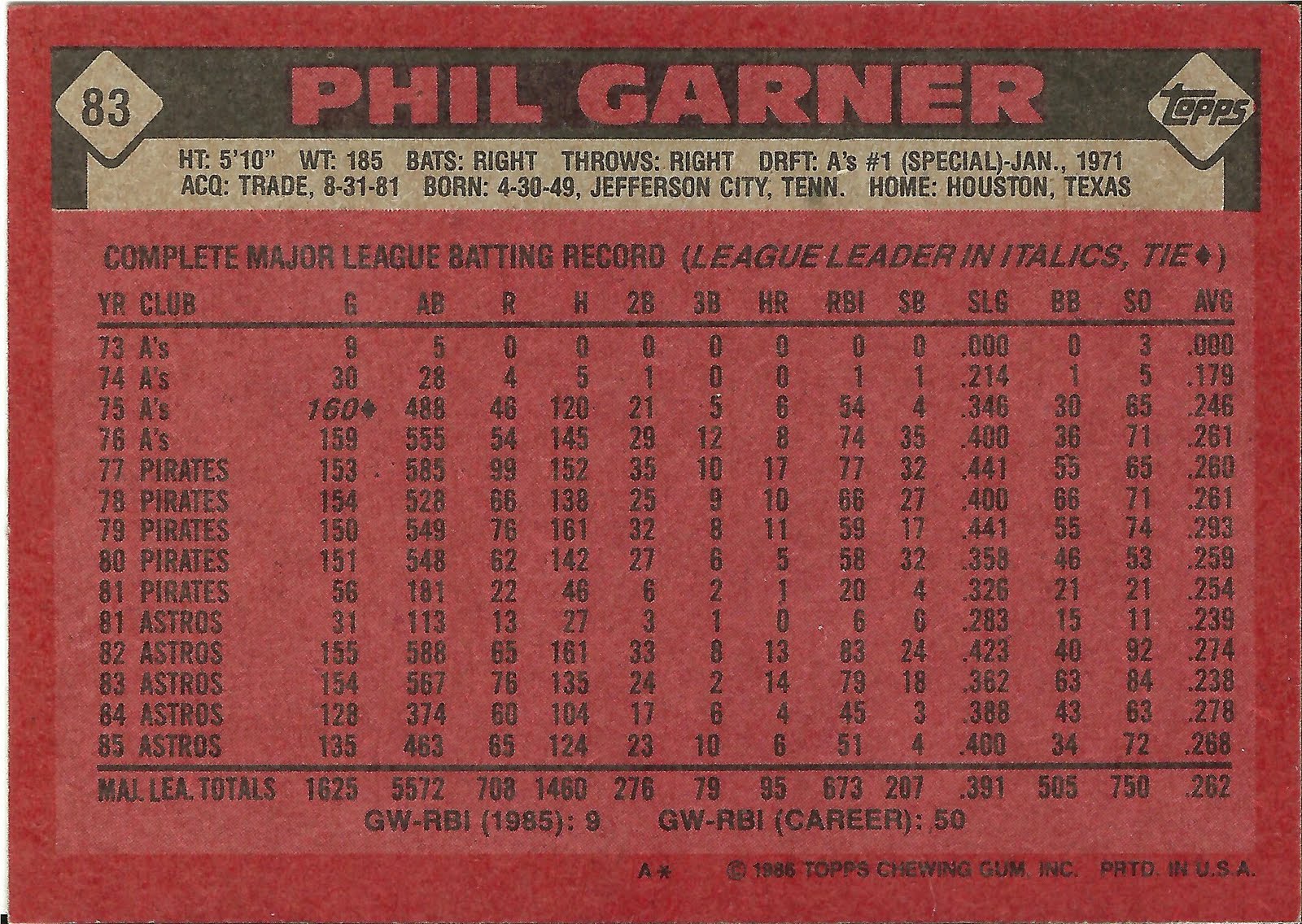
#83 Phil Garner


Card thoughts: A really awkward looking card. Phil Garner's trademark mustache looks like its been dyed blond.

The player: Phil Garner was nicknamed "Scrap Iron" for his scrappy play and resemblance to this cartoon character. One of the better hitting second baseman in the 70s and early 80s, Garner drove in over 70 runs 4 times and generally scored over 60 runs a year which may not sound like much by today's standards, but in that lower scoring era it was enough to send Garner to the all-star game in 1976, 1980, and 1981. His best season was in 1977 with the Pirates when he scored 99 runs, hit 17 home runs, drove in 77, and had a fine .441 slugging percentage. The next year, he hit grand slams on consecutive days. But Garner's reputation with the Pirates was made in 1979 in the post season when he hit .417 in the NLCS and an incredible .500 in the World Series.

In 1981 he was traded to the Astros for second base prospect Johnny Ray (who would go on to have a very good career for the Bucs). He was shifted to third base in 1983 to make way for a very similar type of second baseman, Bill Doran. His post-season magic did not translate to the Astros: He hit .111 in the 1981 ALCS and .222 in 1986. After 70 games with the Dodgers in 1987 and 15 with the Giants, Garner retired, and started on his next career as a manager. He managed 7 years with the Brewers (where they began to play the National League-style ball that made them a natural fit when they shifted leagues in 1998); a bit more than 2 years with the Tigers, and 4 years with the Astros where he had his greatest success, leading the team to the playoffs his first two seasons, getting to the World Series in 2005 where they lost to the White Sox.


Rear guard: Only 160 games were played in 1975 for some reason I can't determine.