Friday, January 31, 2014

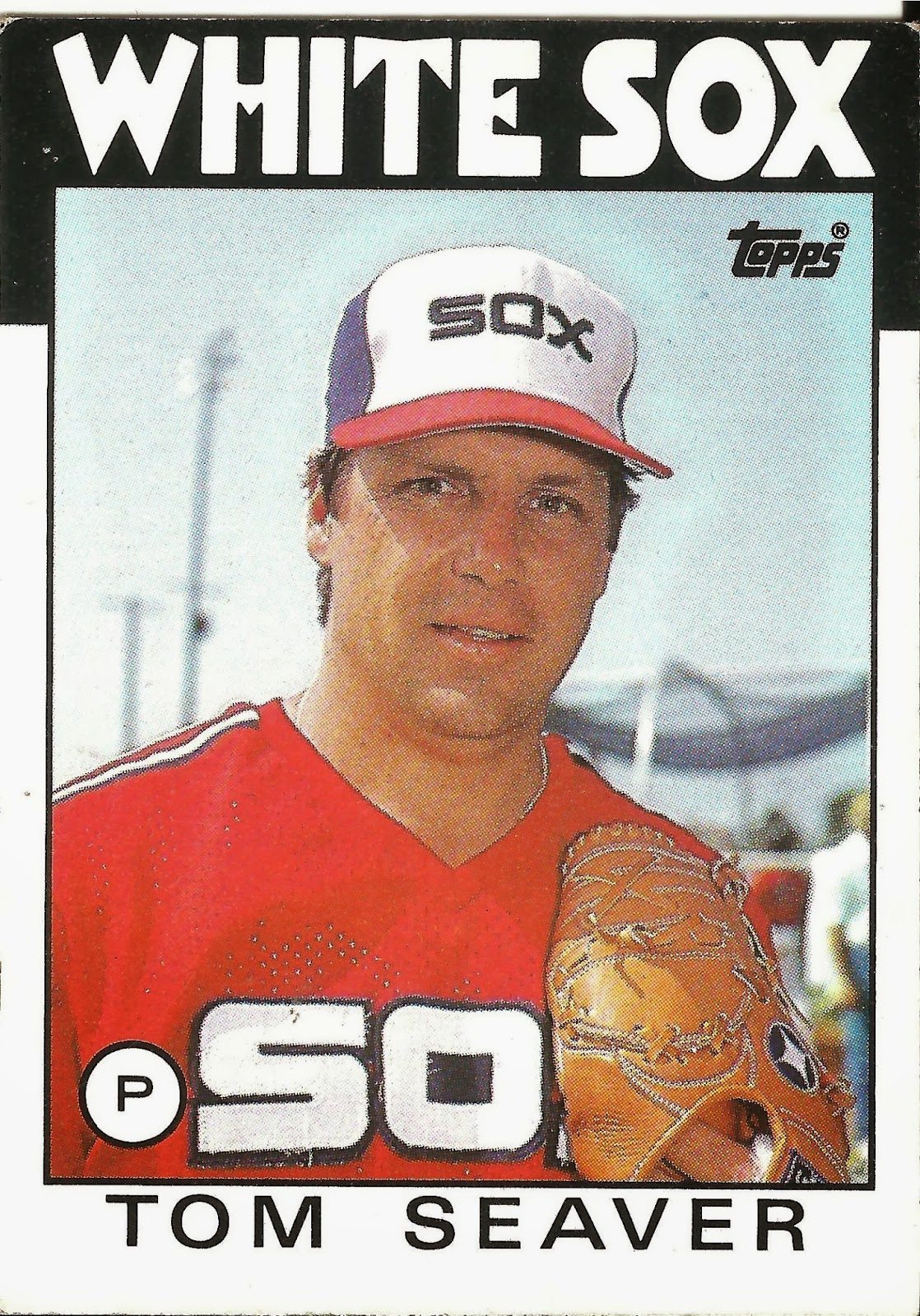
#390 Tom Seaver


Card thoughts: Nearly the end of the line here for "Tom Terrific". And it’s too bad that his last card as a White Sox player shows him in that awful mesh softball jersey they wore in spring training.

The player: Tom Seaver was one of the most dominant pitchers of his era (or any era). Pitching with a classic overhand motion, Seaver’s fastball touched 95 mph, in an era when that was rare. He supplemented that with a devastating slider and curve. But Seaver was more than just a power pitcher. From a very early age, he knew how to set up hitters. The ability of Seaver to hit his spots with uncanny consistency for such a long time (he was the league leader in wins at age 36), made him an easy first ballot Hall of Famer (in fact, his 98.8% voting percentage is the highest in Hall of Fame history).

A star pitcher at USC, Seaver was involved in a curious contract dispute before his career even began. The Atlanta Braves illegally signed Seaver while the college season was still in progress. The commissioner’s office voided the contract, and conducted a lottery of Seaver, with just three teams, the Indians, Phillies, and Mets, willing to match the Braves’ signing bonus. The Mets won, and it was just like winning the real “lottery.” Seaver spent just one year in the minors at Jacksonville before becoming a major league star in 1967.

The Mets at that time were a terrible team, but they had a lot of good young pitching. Seaver went 16-13 as a rookie (for a tenth place team), winning Rookie of the Year honors. He also pitched in the first of seven straight all star games, this time earning a win.

1968 was another year where Seaver had a miniscule ERA (2.20), but a barely above .500 win loss record (16-12). That would all change in 1969. As the ace of the Miracle Mets, he finally had a decent offense behind him, as he led the league in wins (25), earning the Cy Young Award in the process.

Picked the pitch the first game of the NLCS, Seaver was bombed by the Braves for five runs in eight innings. He fared a bit better in the World Series, winning 1 and losing 1. There was a rumor going around that if the Mets won the World Series, Seaver was going to put an ad in the New York Times denouncing the Vietnam War, which he said was unfounded. His picture, however, was used (unauthorized) for Moratorium Day flyers handed out before Game 4.

Seaver became even more dominant in the early 70s. Learning to harness his control, he routinely led the league in ERA (1970, 1971, 1973) and strikeouts (the same years). He even got a chance to go back to the World Series in 1973, but the Mets lost to the A’s. Seaver pitched well as always, but the weak Mets offense failed to back him up (his losses in the post-season: 2-1 to the Reds and 3-1 to the A’s). For his regular season work, Seaver would earn his second Cy Young Award, the first awarded to a player who had failed to win 20 games (he won 19).

A sore shoulder that Seaver had developed near the end of the 1973 season (perhaps due to seven straight years of pitching over 250 innings) limited his effectiveness in 1974. His 11-11 record, 208 innings pitched, and 3.20 ERA were all career worst numbers. Considered the clubhouse leader of the Mets (and a franchise player), rumblings appeared in the press that Seaver was becoming a surly, malcontent. But he didn’t let the press get to him and 1975 was a bounce back year, as Seaver led the league in wins (22) for the first time since 1969, once again earning the Cy Young Award.

Although his win total dropped in 1976 (14), his league leading 235 strikeouts marked the ninth straight year he had topped 200 strikeouts (this was a record at the time). But changes were coming to baseball. Free agency had tentatively began, and Seaver wanted a big contract which the Mets owner was loathe to give out. Instead, he signed an incentive laden contract, which led to friction between him and the front office. This was the background for what is considered the worst trade in Mets history.

After previously threatening to trade him for #335 Don Sutton (not too bad of a trade, considering who he was actually traded for), the Mets finally pulled the trigger in 1977. Seaver was being jerked around by both management and the press, and he was sick of it, refusing to sign a deal he had (in principle) extending his contract, and remaining a Met. He demanded a trade, and, without leverage, the Mets made a bad one, sending Seaver to the Reds for a bunch of young players, none of which turned out to be much good.

With the trade, there seemed to be a load lifted off Seaver as he went 14-3 the rest of the way with a 2.34 ERA. But although he was still an “ace”, it was inevitable that Seaver began to slow down as he approached his mid-30s. Although he still had effective years for the Reds, only once was his arm strong enough to put them in the post season (1979). Although he had a renaissance year in 1981 leading the league in wins (14), his shoulder problems surfaced, and his 5-13 record in 1982 showed Seaver’s age. The Big Red Machine was aging as well, and the team needed to turn over a new leaf.

So the Reds sent him back to the Mets for a homecoming of sorts. As the Opening Day starter, Seaver drew 48,000 fans to Shea Stadium for a franchise that had become moribund since the trade of Seaver. But he had another sub par year at 9-14, a looked to be done at 39. So the Mets left him “unprotected” which allowed the White Sox to “claim” him after losing Dennis Lamp to free agency.

Pitching mostly with guile, Seaver won 15 games in 1984 and 16 in 1985 with the White Sox, including win 300 at Yankee Stadium. But the end was near, and after another half season with the White Sox, he was dealt to the Red Sox for #233 Steve Lyons, where he finished his career.

If you judge a pitcher by his WAR, Seaver is the seventh best pitcher of all time (JAWS says sixth). Besides going into the Hall of Fame in 1992, Seaver has broadcast games for the Yankees and the Mets, and now runs a winery in California that produces a small batch of Cabernet Sauvignon. He also recently battled a bad case of lyme disease, which he thought was early onset dementia.


Rear guard: One thing that sucks about these long careers is that the small print makes it really hard to see what categories Seaver led the league in (always my go to when I was young to assess whether the card was any good).

Tuesday, January 28, 2014

#389 Glenn Davis


Card thoughts: This is Glenn Davis’ first Topps card, but I also owned his rookie card, on which he was incongruously paired with Joe Hesketh. For years, this card occupied a prized place in my collection.

The player: What happened to Glenn Davis? Part of a large crop of up and coming slugging first baseman in the mid-80s, his time as a star player was brief.

Davis grew up in a troubled household. His father, a failed minor league infielder, would take out his frustrations on his son. His mother, a bible thumping type, routinely beat him. Suicidal and violent in high school, Davis still starred on the field. When he reached college, the athletic director “adopted” him (the director’s son—Storm Davis—also became a major league player.)

Fighting his personal demons all through the minors, Davis stopped womanizing and drinking when he became a born again Christian. After driving in 94 runs at Tuscon in 1984, Davis got a brief taste of the majors at the end the year, hitting .213 in 18 games. Perhaps suspecting his maturity, Davis again started the year at AAA in 1985, with veterans #197 Enos Cabell and Denny Walling splitting time at first. But with the trade of Cabell midseason, a spot opened up for Davis and he grabbed the opportunity, hitting 20 home runs in just 350 at bats, coming in fifth in Rookie of the Year voting.

Davis really burst out in 1986, however. With a profile on him in People magazine and the Astros on their way to a division title, he scored 91 runs, hit 31 home runs, and drove in 101. He was a bright spot in the NLCS as well, hitting .265 overall, and going 3 for 7 in the 16 inning marathon that was Game 6. At the end of the season, Davis finished second to #200 Mike Schmidt in MVP voting.

Davis consistently put up good power numbers over the next three seasons, generally hitting above 25 home runs, and driving in at least 85 runs. However, as a precursor to the rest of his 1990 season, Davis was it 3 times by Reds pitchers on Opening Day. He later missed much of the second half of the season with a rib injury. Despite appearing in only 93 games, he led the league in being hit by pitch (8).

In what was seen as a good trade at the time (given his track record), Davis was traded to the Orioles in the offseason for three future all stars (Steve Finley, Curt Schilling, and Pete Harnisch), although Finley and Schilling became stars after they moved on from the Astros. The trade is now considered one of the worst in Oprioles history, especially as Davis suffered a pinched nerve in spring training in 1991, limiting him to just 49 games that season (and an abysmal .227 average).

Even in his bounce back year (1992) Davis was a shell of his former self, as he could only muster 13 home runs and 48 RBIs. But 1993 was a disastrous season, which effectively ended Davis’ major league career. Hitting just .177, and apparently going back to his former bad ways, his jaw was broken in a bar fight. After getting back from the DL (and subsequently sent down to AAA), he was sitting on the bench after being called back up, when he was hit in the head by a line drive during a game. Finally cleared to play in September, he got in a shouting match with manager Johnny Oates about his lack of playing time, leading to his release.

Now with a reputation as an oft-injured malcontent, Davis could only land a job at AAA with the Royals. But despite hitting well there, he wasn't called up, and eventually ended his career in organized ball with the Hanshin Tigers in Japan.


In retirement, he’s become a bit of a big wheel in Columbus, Georgia, where he started a home for disadvantaged children, holds a seat on the city council, and owns a hotel in town.


Rear guard: Davis' first hit was in his debut. He doubled off cardinals pitcher Ricky Horton.

Monday, January 27, 2014

#388 Dickie Noles


Card thoughts: That is one unfortunate nickname. It is very rarely used today. Also, almost every picture of Noles in the early days shows him with that enormous wad of chaw in his cheek.

The player: Legendary hothead Dickie Noles was known for a fierce fastball (topping 90 with regularity) and fierce demeanor on the mound (he was a legendary headhunter). He was the Carlos Zambrano equivalent for the Cubs in the early 80s. But his early promise never really translated into success, as his problems with alcohol and anger doomed him to a life as a marginal pitcher.

Noles reputation as a no-holds-barred pitcher came early. As a minor leaguer for the Phillies in the late 70s, he led the league in hit batters in the Western Carolina League, the Carolina League, and the Eastern League. Despite the wildness, no one could deny that Noles had a great arm, and he when he was called up in July of 1979, he was effective as a starter. In 14 starts, he kept the wildness in check (38 walks, 2 wild pitches, and 2 hit batters in 90 innings). However, he didn’t have the ability to go deep into games, so in 1980, he was shifted to the bullpen. Although Noles’ walks per nine innings went up, he did save 6 games. In perhaps his most memorable appearance in the majors, he relieved struggling starter Larry Christensen in Game 1 of the World Series that year in the first inning, and proceeded to shut down the Royals for the next four innings. What he is most remembered for, however, is throwing a little chin music to #300 George Brett (at 1:06:08 in this video). This pitch is credited with shutting Brett down for the rest of the series.

When Noles manager in that series, Dallas Green, became the GM of the Cubs, he began a wholesale pilfering of the Phillies young players, and Noles came to the team, along with #266 Keith Moreland, for Mike Krukow in 1982. Noles was again tries as a starter for the Cubs, and he went 10-13 that season, but with a high 4.42 ERA. His pitching wasn’t helped by his alcoholism, which led to him getting into several drunken brawls. The most infamous of these came at the beginning of the 1983 season, when he pummeled a cop trying to break up a fight at a bar where Noles was drinking. He was sentenced to 16 days in a Civil War-era Cincinnati prison, and later entered rehab. The season was a wash as well, as Noles suffered through a 5-10 season as both his strikeouts, and walks, went down.  Part of the problem was that in the fight he injured his knee, robbing him of his great fastball.

With a 2-2 record and a 5.15 ERA, Noles was the proverbial last man out of the bullpen in early 1984, before the Cubs finally tired of waiting for him to regain his fastball. He was shipped to the Rangers for two forgotten minor leaguers in July, where he failed to right the ship.

Tried again as a starter in 1985, his 5.54 ERA in the rotation hastened him into the bullpen by the end of the season, where he was marginally more effective. While Noles still had the great arm, some of his mound fierceness had left him once he quit drinking. While not as wild, he wasn’t striking out many either, and these traits made it hard to stick with any one club for very long. With the Indians in 1986, he was in the bullpen again, but he struck out barely more than he walked, so he was on the move again, this time back to the Cubs. Here, he would have his last effective season, going 4-2 with a 3.50 ERA. In a strange twist, Noles was sent to the Tigers in late September for a player to be named later, who turned out to be Noles himself, when no player was agreed upon (his card that year reads "Now with Tigers"). Which really didn’t make much of a difference, as he was granted free agency and later signed with the Orioles.

Noles would pitch just three more games after the 1987 season. He later became a born-again Christian, and spends much of his time giving anti-alcohol abuse lectures, using his own travails as an example. Noles also serves in the Phillies front office as the employee assistance professional, a kind of counselor to players battling stress, addiction, or mental illness.


Rear guard: Much has been written about David Clyde, mostly as a cautionary tale not to rush young pitchers into the majors. Basically, the Rangers needed an attendance boost, and the owner was the kind of idiot who would permanently damage a young player's arm to get it. Clyde had graduated from high school just 20 days before his debut, where he gave up just 2 runs in 5 innings, despite walking 7 (he also struck out 8). It was planned that he'd just make a few starts before being sent back to the minors, but he was kept in the rotation the rest of the season, which eventually ruined his arm. Here's his card from that season, one of only three issued by Topps in his all too brief career.