Monday, October 21, 2013

#367 Auerlio Lopez


Card thought: This is the last time Lopez was appear as a Tiger on a Topps card. He was an Astro by the following season. Interesting note: Lopez’ previous two Topps cards show him in almost identical poses.

The player: Lopez was a star in the Mexican League way before he made it to the majors for good at age 30.  There’s even a statue of him in his hometown.

Lopez started in the Mexican minor leagues, but was soon promoted the “majors" in 1968, at age 19. He had several outstanding seasons in the Mexican League, leading the Mexico City Reds to the World Series in 1974, and winning 19 games in 1977 (as a closer!), earning MVP honors along the way. He was known in Mexico as The Vulture of Tecamachalco.

Lopez was first brought to the American “major leagues” while on loan from Mexico City to the Royals in 1974. Used for the stretch drive that season, he had a mediocre 5.63 ERA in 8 games. His contract was bought back by Mexico City, and he wouldn’t again appear stateside until the Cardinals bought him in 1978.

Permanently a major leaguer now, he was swifty traded to the Tigers after the season with Jerry Morales for Jack Murphy (never made the majors) and Bob Sykes (three mediocre years as a Cardinal). With the Tigers, Lopez’ career really took off. A 10-5 record in 1979 (to go along with 21 saves) earned him consideration in the Cy Young award race. He had a nearly identical year in 1980, establishing himself as one of the top relievers in baseball.

Despite his closing prowess, he shared closing duties with Kevin Saucier in 1981. It was good that the Tigers had Saucier in reserve, because Lopez was felled by shoulder problems for much of 1982. At one point, he quit the team after being sent to the minors for much of the year. One of the reasons Lopez gave was the Mexican economic situation, thought to have referred to the cratering of the Mexican peso, which led to the government to pressure Mexican nationals living abroad to retain their resources in the home country.

Regretting his decision, he returned to the Tigers 1983, despite being the first player to ever get his pay cut in arbitration. Lopez didn’t let that set him back, as he returned to form, going 9-8 with 18 saves. He was even more spectacular the following season. Considering that Willie Hernandez won the Cy Young as the Tigers closer that year, Lopez record of 10-1 with 14 saves and a 2.94 ERA really shows how strong their bullpen was.  In the playoffs, he pitched in three games and didn’t give up a run. Confusingly, Auerlio was referred to as Señor Smoke, the same nickname later given to teammate #47 Juan Berenguer.

But Lopez was now 36, and his arm was growing tired. The Tigers stumbled to a 84-77 record in 1985, and lack of bullpen depth was one reason. With Hernandez taking more and more closing opportunities, the aging Lopez was given middle relief duties and he struggled, putting up a 4.80 ERA. Granted free agency, he signed with the Astros and pitched two more seasons with them before retiring in 1987. During spring training of his last season, he got a DUI.

Lopez was so popular in Mexico, that he was elected mayor of his hometown of  Tecamachalco. During his stewardship, a municipal water and sewer system was developed. In the rough and tumble world of Mexican politics, the previous mayor’s loyalists shot up his house a couple of times, but Lopez remained mayor until his death in a car accident in 1992. Eerily, all three Auerlios in major league history died in car accidents in their mid 40s or early 50s. After his death, he was named to the Mexican Hall of Fame.

Still remembered fondly in Detroit, local band Electric Six named their 2006 album Señor Smoke in a tribute to him.


Rear guard: Note that the Mexico City "Reds" are correctly referred to as "Rojos" as the team that signed him first in 1967. Lopez' debut was a poor one. He pitched 2 2/3 innings and gave up 4 hits and 2 runs in relief of Steve Busby.

Monday, October 14, 2013

#366 Reds Leaders


Card thoughts: The Reds were a team that finished second in the AL West in 1985 (89-72). Part of that is attributable to Rose's skill as a manager, as they had only a few standout players. But they were a well constructed team.


The player: Very dirty corners on this card. Of course, #1 Pete Rose and  #85 Tony Perez predate Davey Concepcion as Reds, but they left the team for a spell in the late 70s/early 80s.


Rear guard: Dave Parker completely dominated the offense: He finished second in MVP voting, and he led the league in RBIs (most of his other totals were in the top ten as well).

Beyond the 1-2 punch of Tom Browning (who won 20 as a rookie despite a league average ERA) and Mario Soto (who would go on to have a much better career than browning), only #176 Jay Tibbs started more than 30 games. Kind of surprising to see #54 John Franco, who would go on to record over 400 saves, play second fiddle to #108 Ted Power.

Sunday, October 13, 2013

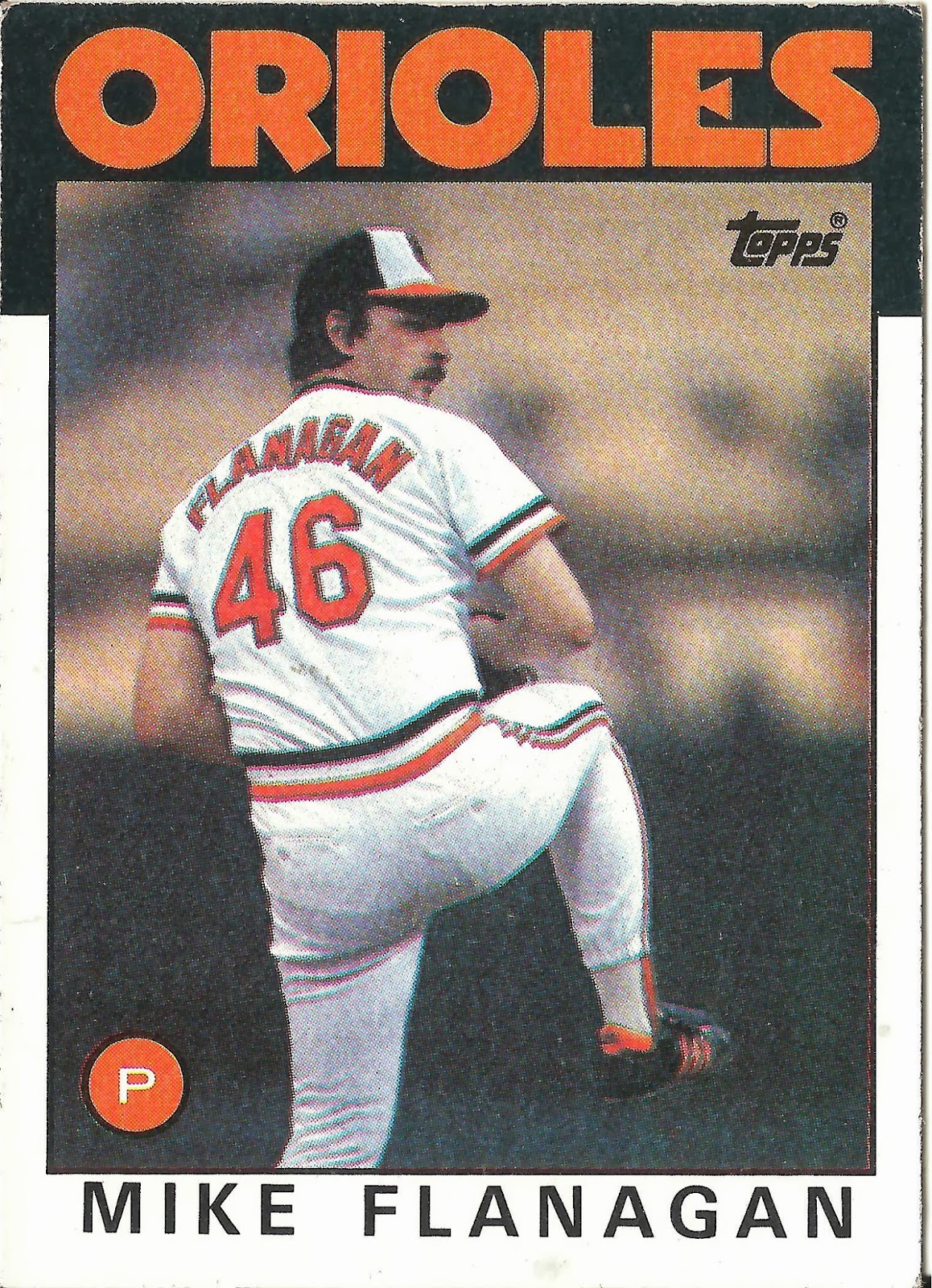
#365 Mike Flanagan


Card thoughts: Flanagan was one of those Orioles starters in the 80s (like #110 Scott McGregor or Mike Boddicker) who, unlike Orioles pitching stalwarts of old, seemed to have a triumvirate of peak years surrounded by years of injury/inconsistency.

The player: A star at the University of Massachusetts, Flanagan’s out pitch was the curve ball, which he threw sidearm to lefties. Although he was never known for low ERAs, his durability led to many wins for Mike, especially in the late 70s.
 
After making 10 starts the previous season, by 1977 Flanagan was a mainstay in the Orioles rotation, pitching the first of 5 straight years (excluding the shortened 1981 season) of pitching over 225 innings. His 15 wins that season, were followed by 19 the next year, as the durable Flanagan led the league in starts, and made his only all-star team on the strength of a strong first half (12-6, 3.53 ERA). Unfortunately, he faded down the stretch and despite the wins, he led the league in earned runs given up and his ERA was above the average.

The 23 wins he earned the next season (leading the league) were more aligned with his peripherals (his 3.08 ERA was a career best), as he helped power the Orioles to the World Series. For his efforts, he won the Cy Young award. In the World Series, he won Game 1 with a complete game, although he gave up 11 hits and four runs. Flanagan didn’t have as much luck in Game 5, although he pitched better overall, giving up just 2 runs in 6 innings.

The success continued for Flanagan in 1980, although it is debatable if he was an excellent starting pitcher, or just a decent one who got a lot of run support. In fact, his 16-13 record belied the fact that he gave up more than a hit per inning (278 in 251+ innings), and was giving up a lot of walks and wild pitches as well.

In his personal life during this time, came a bit of a milestone, as his daughter was only the eighth baby born in the United States using in-vitro fertilization in 1982 (and was the first to be born naturally, not via Cesaerian section).

Flanagan would be a pitcher who today would have trouble getting past the sixth inning, what with the high pitch counts and all, so the wins are a little deceiving. But Flanagan would remain a just-above-.500 pitcher, with greater than 10 wins a year until the season represented by this card, when he managed just 15 starts, and had an ERA over 5.
 
As went the Orioles fortunes, so did Flanagan’s. A star pitcher for a star laden team, by the late 80s the team was bad, and so was he. After a couple more years of inconsistency, he was shipped to the Blue Jays midway through the 1987 season for Jose Mesa and Oswaldo Peraza (who?). Down the stretch, he was 3-2 with a 2.37 ERA, but his acquisition did not propel the Blue Jays into the playoffs. In his first full Blue Jay season, Flanagan would go 13-13 and pitch over 200 innings for the last time. The Jays would finally make the playoffs during Flanagan’s tenure in 1989, but he was terrible in his only start, going 4+ innings and giving up 5 runs.

Released by the Blue Jays after the 1990 season (when he only made 5 starts), Flanagan had a last hurrah for the Orioles, as he made the team as reliever out of Spring Training. He got into 64 games and had a fine 2.38 ERA. Flanagan struck out Travis Fryman at the end of the year to record the last out in Memorial Stadium history. But in 42 games the next year, he had an atrocious 8.05 ERA, convincing him to retire.

After retirement, he held a variety of roles with the Orioles, including pitching coach, general manager, and broadcaster (a role held for three non-consecutive times). Here’s an example of his insight (note the New England accent).

Despite his success, it was noted early on that Flanagan had a sullen demeanor, and when he left the mound, whether the inning was good or bad, he would be brooding. Apparently, he never felt like a success, and his trademark self-effacing humor masked a constant feeling of insecurity. In proper proportion, this self-doubt can be a goad for an athlete to constantly push his or herself to greater heights. But it is dangerous to have too much self-doubt in baseball, because, as has been said, even the greatest hitters fail about 70% of the time, and pitchers will make at least 5 or more mistakes every start.

Struggling with depression for most his adult life, and facing an uncertain financial future (his intermittent employment with the Orioles being the cause of some of this angst), Flanagan tragically shot himself last year. Here’s a pretty good explanation of what led up to the suicide.


Rear guard: Flanagan's first win was against the Royals. He went the full 9, his only mistake was giving up a sacrifice fly to #344 Jim Wohlford in the fifth inning that scored Dave Nelson.