Monday, December 30, 2013

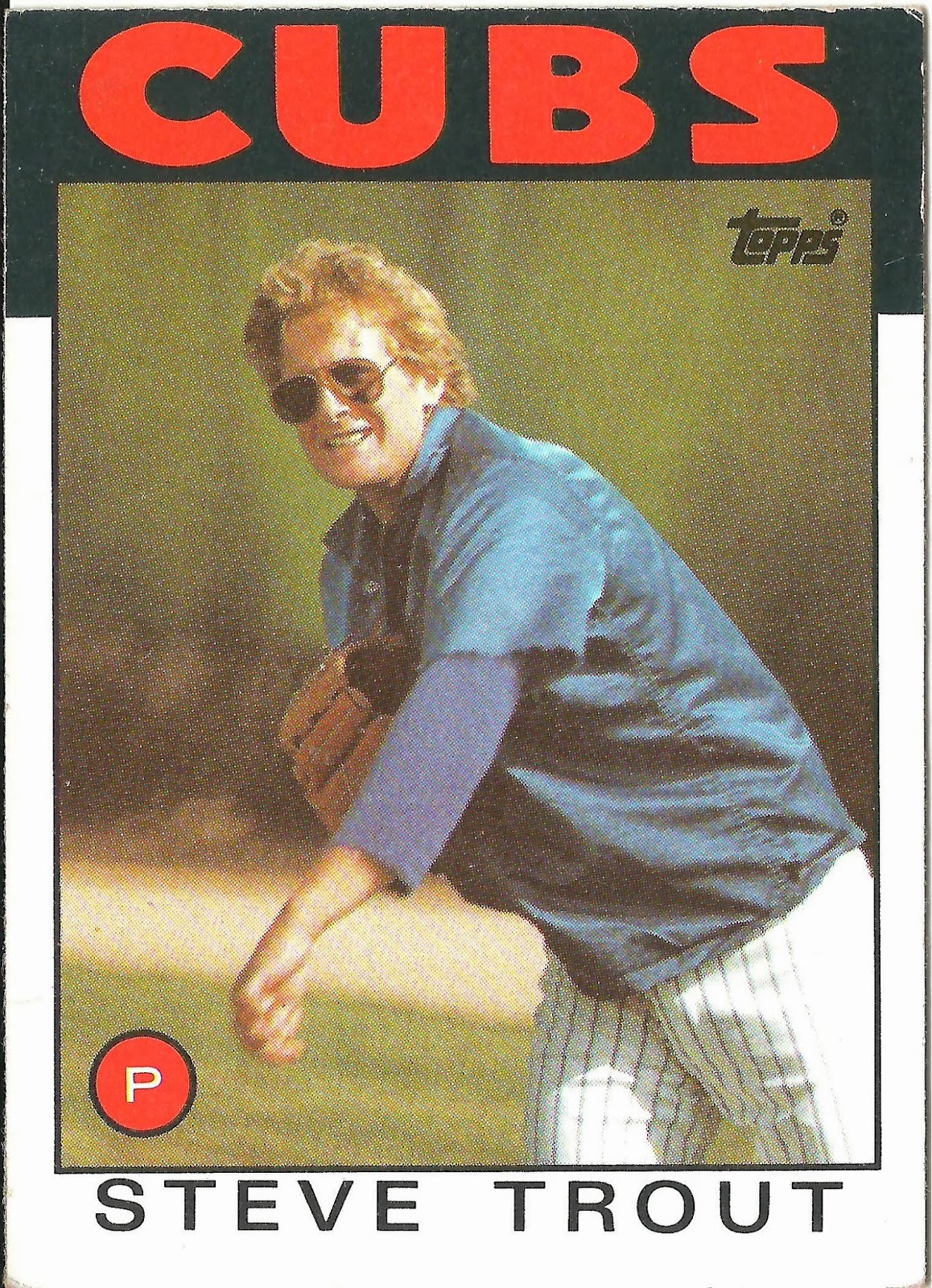
#384 Steve Trout


Card thoughts: Trout looks like a paunchy middle aged fantasy camp participant in this picture, as there is little to show that he’s an actual baseball player (save the striped pants). This was not the only card where Trout sported his poodle-fro to the fullest: He looks particularly hesher on his 1981 Topps card.

The player: Trout one of those guys that lazy broadcasters (like Joe Buck) like to describe in shorthand as a “flaky” lefty. Maybe flaky because the guy spouts things other than sports clichés when quizzed after games in the clubhouse, or perhaps because his nickname is “Rainbow.” Or maybe it was because he would challenge teammates to burrito eating contests when they were on the West Coast.

A local boy who had the luck to play with both Chicago teams (Don Pall and Phil Cavaretta are the only other local players  I can recall who did that), Trout was the son of famed starter Dizzy Trout, who won 170 games, mostly with the Tigers. Not only that, his grandfather worked for Bill Veeck, who owned both the Cubs and the White Sox 9although not at the same time).

As was the custom of the time, Trout “apprenticed” his first full year in the majors as both a starter and a reliever, having more success in the former role (10-6, 1.45 strikeout-to-walk ratio as a starter) than the latter. Given a more substantial role in 1980, he foundered, ranking fourth in the league in losses (16) and leading in hit barters (9).

A couple of mediocre years followed, with Trout ineffective due to injury and increasing wildness. The White Sox finally gave up on him after the 1982 season, completing a rare big trade with their crosstown rival Cubs, with #187 Scott Fletcher, Pat Tabler, Randy Martz, and Dick Tidrow going the other direction.

While Trout’s first season with the Cubs was unmemorable (except for his notable disdain for signing autographs), he was a key part of the Cubs pennant drive in 1984 when he, like many players on that team, had a career year, going 13-7 with a 3.41 ERA. He continued his strong pitching in the division series, winning Game 2.

Trout started strong in 1985, but a nerve condition in shoulder sent him to the DL—along with what was basically the rest of the starting rotation—for half of the season. Although he had a winning record and low ERA (3.39), storm clouds were ahead. Trout for the first time walked more (63) than he struck out (44), a curse that would plague him the rest of his career. Trout ‘s alarming increase in wildness was upping his pitch count so much, he was having a hard time going deep into his starts. So much so, that he was bounced from the rotation in the middle of the following year.

It seemed, however, that Trout was making a comeback in 1987. He started strong once again, going 6-3 with a 3.00 ERA. His last two starts with the Cubs were shutouts, before he was traded to the Yankees for three young pitchers who never did squat for the Cubs (although Bob Tewksbury went on to have a flukily good couple of years with the Cardinals in the early 90s).

With the Yankees, his control problems returned with a vengeance. In just 46 1/3 innings, Trout threw 9 wild pitches and walked 37. He couldn’t get past the sixth inning in any of his 9 starts.

Feeling burned, the Yanks essentially paid for Trout to go away, sending him to the Mariners with a cool million for three more young pitchers. The Seattle team foolishly elected to make Trout their Number 2 starter, and his first start for the team (2/3 of an inning pitched, 5 walks, 2 wild pitches) was an prelude to the rest of his season (31 walks, 7 balks(!), and 5 wild pitches in 56 1/3 innings with an ERA over 7).

Trout barely pitched in ’89 (and badly at that), before being released in June for good. In retirement, he’s managed a baseball camp, done some indy league coaching, and once coached a high school baseball team in Hawaii after answering an ad in the paper.

He still lives in the Chicago area (and has a very Rainbow-brite looking Website), and oddly enough the site lists his home address (a tiny bungalow in a working class area of Hammond, IN), so maybe Trout will sign your autograph now that he’s retired.


Rear guard: Chick Tolson was a mighty minor league slugger (career slugging percentage: .621) who found it hard to crack the lineup during a time when Cubs teams regularly hit above .280. His grand slam came off Pirates starter Ray Kermer, and he was pinch hitting for long forgotten reliever Percy Jones. Tolson would hit just 4 home runs in a 5 year career.

Sunday, December 29, 2013

#383 Chris Brown


Card thoughts: Chris Brown in the #12 Jose Uribe pose. Note the initials on the underside of the bill of his hat. If Topps had returned to the “All-Star Rookie” cards just one year earlier, you’d be seeing a cup on this card.

The player: A high school teammate of Darryl Strawberry, Brown was a second round draft pick in the 1979 draft. Despite an ordinary minor league career, he made his debut in 1984, hitting .286 over 23 games.

The incumbent starter at third base, #177 Joel Youngblood, was really just there as an emergency measure. When he moved back to his customary utility role in 1985, Brown surprisingly earned the job out spring training. After hitting 16 home runs and driving in 61, he placed fourth in the Rookie of the Year balloting. If anything, his fielding at third stood out even more, as he led the league in fielding percentage, and showed excellent range at that position.

Brown continued his hot hitting in 1986, as he made the all star team after hitting .338, with an .877 OPS at the break. Despite finishing the year in the top ten in batting (.317), he barely played at all during September due to a shoulder injury. Initially, doctors could find nothing wrong with Brown, and he was accused of being a malingerer. But further examination revealed a problem, and he was sidelined for part of the next season.

Perhaps Brown enjoyed getting paid for not playingor he was resentful that his injury claim wasn’t believedbecause for the rest his career, he was noted for claiming bizarre injuries in order to get out of the lineup. That may have been why the Giants gave up on Brown so soon after his standout 1986 campaign, shipping him in a huge deal to the Padres in July of 1987.

Although he still hit for power, Brown’s average plummeted to .232, and he was in and out of the lineup that year and the next. The Padres, like the Giants, finally tired of Brown’s lackadaisical attitude (he was nicknamed the “Tin Man”—no heart) and sent him with #266 Keith Moreland to the Tigers for Walt Terrell. Sparky Anderson was a no-nonsense manager and, when Brown claimed he couldn’t play in a game because he slept on his eye wrong, that was the final straw and he was released. After a short stint with AAA Buffalo (Pirates), Brown retired from baseball at the young age of 28.

In retirement, Brown worked in construction where he was just as injury prone. While working on the Getty museum in LA, his cement mixer keeled over and Brown injured his back and neck. After relocating to Houston and operating a crane, he ended up driving a transport truck for Halliburton during the Iraq war where he was shot at multiple times. So ironically, the man who was considered “soft” while playing baseball ended up taking a job that required more courage than most of his “tough guy” teammates ever showed. Perhaps it wasn’t that Brown was a weakling. Maybe, despite his talent, he just didn’t like playing baseball and he just slacked off instead of quitting.

Brown died under mysterious circumstances in Sugar Land, Texas (a suburb of Houston) in 2006. After his tour of duty in Iraq, his life fell apart, and he burned to death in a vacant house he owned, and no one knows whether the fire was intentional or an accident.


Rear guard: Brown's first hit was a single leading off the fifth inning with the Giants getting slaughtered 10-1. He was soon erased at second on a ground ball to short by perennial Mendoza line flirter #289 Johnnie LeMaster.

Sunday, December 22, 2013

#382 Ivan Calderon


Card thoughts: This is not the follow through you want to see from a hitter. Calderon looks badly fooled.

The player: Calderon was a slugger in the minors, but found it hard to get playing time with the Mariners. A trade in late 1986 to the White Sox would make him a star—for a very brief period.

Finally afforded regular playing time with the Sox in 1987, Calderon reached career highs in runs (93), and home runs (28), while driving in 83. Although set back by an injured shoulder the following year, he rebounded in 1989, driving in a career high 87, although with his weakened shoulder, his power fell off.

Strangely enough, at age 28, Calderon’s game completely changed, and he began to steal bases and hit more doubles than home runs. His 44 doubles in 1990 were third in the league, and his 32 steals placed him in the top 10 in the American League. Calderon also was known to sacrifice and drop suicide squeezes down, even though he batted in the cleanup spot most of the time. He even improved his normally pedestrian play in the outfield.

Although he was a fan favorite in Chicago, with his flamboyant style of play and gold chain necklace (then a rarity among baseball players), he was shipped off the next year to Montreal, with Tim Raines the key player going back to White Sox.

Calderon would have one good season with the Expos. His line in 1991—19 home runs, 75 runs batted in, and 31 steals would be enough to earn his only all star game nod. But Calderon was a large man playing on artificial surface, and he wasn’t the best at taking care of himself. Leg injuries limited him to just 48 games in 1992, and by 1993, with short stops in Boston, and again Chicago, his career was done.

No more was heard from Calderon until he became a target in his native Puerto Rico. He was murdered at a notorious bar in Loiza by unknown gunmen who shot him multiple times in his back. After retirement, Calderon had apparently found work as a bail bondsman and loan shark, among other occupations (he also raised fighting cocks), but the likely motive for his killing was the fact that his son had apparently been involved in killing a member of a local drug gang. When Calderon refused to turn over the boy, they shot him instead. 


Rear guard: John Montague is neither the Irish poet who wrote "A Slow Dance," nor the 4th Earl of Sandwich. Rather, he was one of the few effective pitchers on the first Mariners team. Montague relieved Tom House in the third inning, and pitched perfectly the rest of the way. Furthermore, in the previous game, he had retired everyone from the 6th to the 9th inning. The streak of 33 consecutive batters retired ended on July 28, when he walked pinch hitter Craig Kucick in the 8th inning.