Tuesday, February 5, 2013

#307 Dave Sax


Card thoughts:  There's always something odd about a catcher without his gear on. This would be Dave Sax’s only Topps card. He was issued a Donruss card (with a stupid looking mustache) in 1984.

The player: Sax is the older brother of previous blog subject #175 Steve Sax. The Sax brothers' careers was more reminiscent of the Aarons, rather than the Alous or Uptons. Almost all of the talent in the family seemed to flow Steve’s way, although he always said that Dave was the better hitter, only he didn't really ever get a chance to prove it.

Signed by the Dodgers as an undrafted free agent the same year as his brother, Dave played with Steve at Lethbridge, Clinton, Vero Beach, and San Antonio. But while the younger brother was making his mark in the majors, Dave Sax was being pigeonholed as an organizational catcher. Many seasons, he wasn’t even the starting catcher on his minor league team.

From 1982 to 1983, Sax got 10 at bats for the Dodgers but never got a hit. He became a 6-year minor league free agent after the 1984 season and signed with the Red Sox. Sax would have his most amount of the playing time in 1985. In 22 games, he managed to hit over .300 while filling in at catcher and the outfield.

The following season, Sax broke camp with the Red Sox as the third string catcher behind Rich Gedman and Marc Sullivan. But it took him so long to get in a game that season he was awarded the a-Trophy award, a mock award given the player that took the longest after being on the major league roster at the start of a season to get into a game (it took Sax 34 games).  Despite hitting .455, it was a small sample size, and it was back to the minors for Sax.

His final two appearances in the majors came in 1987 with the Red Sox. Afterwards, he hung on in AAA until 1992.
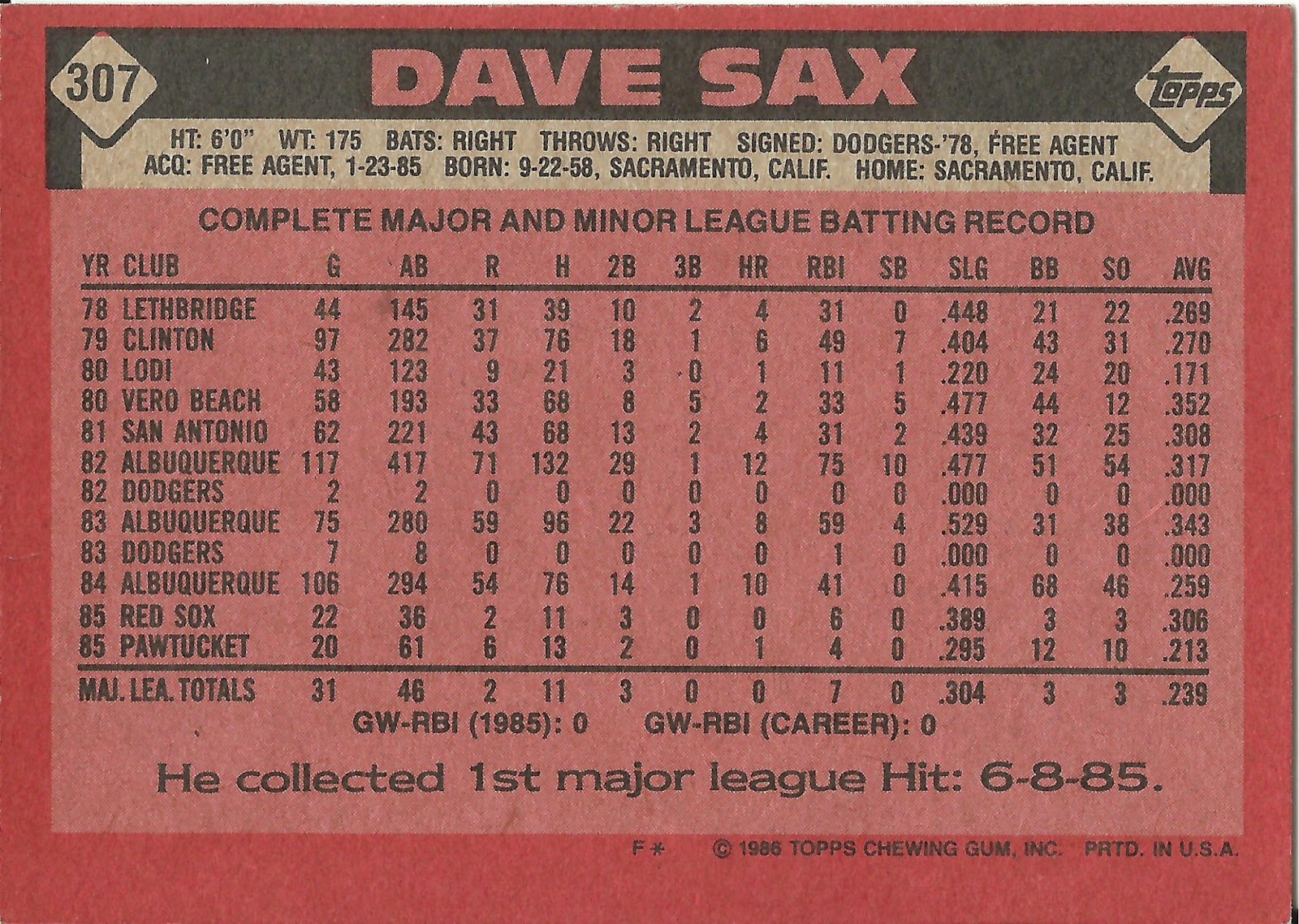

Rear guard: Sax's first hit (a single) was right in the middle of a rally where the Red Sox would score 2 runs.

Sunday, February 3, 2013

#306 Padres Leaders


Card thoughts: The Padres, coming off a pennant the year before, slipped to third in 1985, although they were still above .500. Their record was 83-79.

The player: Okay, although it is true that #230 Terry Kennedy arrived in a trade the winter of 1980, he didn't play his first game with the Padres until April 9th, 1981. #297 Tim Lollar, who was traded at near the end of the 1985 season, made his Padres debut a few days later. Tim Flannery and #262 Mario Ramirez also made their debuts that season.


Rear guard: This card is badly miscut and more worn than usual on the corners. The one surprise on the batting side is #67 Carmelo Martinez, leading the team with 21 home runs. He'd never again hit this many.

Note the strange font on Andy Hawkins. Despite the addition of big game pitcher LaMarr Hoyt, he had the most wins on the team. The variety of the pitching leaders shows the depth of the Padres starting rotation. Every pitcher but #37 Mark Thurmond had a record above .500 and had double digits in wins.

According to the WAR statistic, the most valuable Padre was #10 Tony Gwynn.

Saturday, February 2, 2013

#305 Phil Bradley


Card thoughts:  Really nice shot of Bradley, eye blacks and all, demonstrating his upright batting stance.

The player: A two sport star at the University of Missouri, Bradley briefly considered quarterbacking for the NFL, but he got a better offer from baseball where he was drafted in the 3rd round by the Mariners.

In the minors, Bradley had little power but hit for a high average. This continued in his first two years in the majors, when he didn’t hit a home run, and his slugging percentage was in the mid-.300s. That all changed in 1985 when Bradley exploded for 26 home runs. He reached the top ten in the league in batting average (.300), slugging percentage (.498), WAR (4.6), hits (192), and total bases (319), and he was one of the best fielding leftfielders as well. In today’s game, Bradley would be suspected of using PEDs, but in this case he just discovered how to drive the ball a bit later than usual. He made the all star team on the strength of these numbers and struck out in his only at bat.

Bradley would never again reach the power numbers he put up in 1985, but he had other tools (such as speed) that made him a force in the middle of the Seattle lineup for the next two years. He never hit below .295 in any full season with Seattle, and managed to score a career high 101 runs in 1987 while stealing 40 bases. Despite the fact that he was, along with Alvin Davis, the core of their lineup, the Mariners traded him to the Phillies after this season for Glenn Wilson and Michael Jackson. The reason was that Bradley had won a big arbitration case before the beginning of the 1987 season, and the Mariners felt they couldn’t afford to keep him.

The trade was largely considered a bust in Philadelphia. Although Bradley scored 77 runs, and hit a respectable .264 (he also led the league in being hit by a pitch 16 times), the Phillies expected him to recreate the 1985 season, which he could not do. Almost exactly a year later, Bradley was shipped off to the Orioles where he raised his OPS over 50 points (mostly on the strength of an increase in triples) in his last season as a regular major leaguer. After a trade to the White Sox at the 1990 trade deadline, Bradley hit only .226. He was not offered a contract after the season and elected to go the Japan. He never made it back to the majors.

Soon after retirement, Bradley coached baseball at Westminister College in Missouri and even taught courses in sports history. He has advised the MLBPA in recent years.


Rear guard: Leon Roberts was in the midst of his best season when he launched his pinch home run. He hit 21 other home runs that year, and also drove in 92 while hitting .301. He would never again have a season like that (much like Phil Bradley! Nice coincidence Topps!).

Roberts actually replaced starter John Hale in the 4th inning in that game after the former was injured. Here's Leon Roberts' card from that season.